
As a personal trainer, you know the frustration: a client starts strong, but their motivation fades after a few weeks. Research shows that 50% of people who start an exercise program drop out within the first six months. The good news? Psychology offers proven strategies to keep clients engaged and progressing. Here are seven evidence-based techniques you can apply today.
1. Build Intrinsic Motivation Through Autonomy
Self-Determination Theory (Deci & Ryan, 2000) identifies three core psychological needs: autonomy, competence, and relatedness. When these needs are met, clients develop lasting intrinsic motivation.
Practical application:
- Give clients choices: “Would you prefer to start with upper body or lower body today?”
- Involve them in program design: Let clients pick 1-2 exercises they enjoy
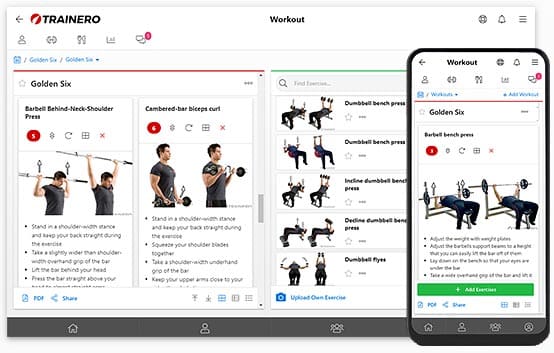
- Use Trainero’s program builder to create multiple workout options clients can choose from
Research insight: A meta-analysis of 184 studies found that autonomy-supportive coaching increased exercise adherence by 38% (Ng et al., 2012).

2. Use SMART Goals with Progress Milestones
Goal-setting theory (Locke & Latham, 2002) demonstrates that specific, challenging goals lead to higher performance than vague goals like “get fit.”
Practical application:
- Break big goals into 4-week mini-goals
- Use process goals (“Train 3x/week”) alongside outcome goals (“Lose 5kg”)
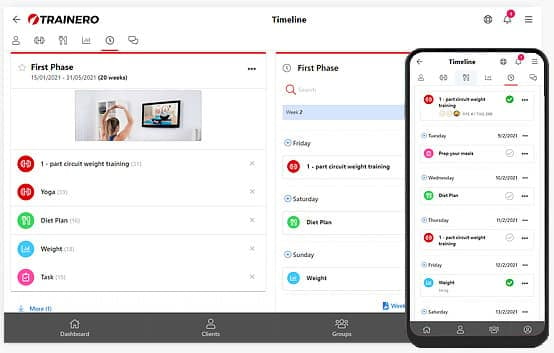
- Track progress visually using Trainero’s progress tracking and measurement features
Example: Instead of “Build muscle,” set “Add 2.5kg to squat every two weeks for the next 8 weeks.”
3. Apply the Stages of Change Model
Prochaska’s Transtheoretical Model identifies five stages of behavior change. Matching your approach to the client’s current stage dramatically increases success rates.
The five stages:
- Precontemplation: Not considering change. Focus on awareness, not action.
- Contemplation: Thinking about change. Explore pros and cons together.
- Preparation: Ready to start soon. Help with concrete planning.
- Action: Actively changing. Provide structure and support.
- Maintenance: Sustaining change. Focus on preventing relapse.
Key insight: Pushing action-focused strategies on a contemplation-stage client often backfires. Meet them where they are.

4. Master Motivational Interviewing Techniques
Motivational Interviewing (Miller & Rollnick, 2012) is a client-centered approach that helps resolve ambivalence about change. It’s particularly effective with unmotivated clients.
Four core skills (OARS):
- Open questions: “What would achieving this goal mean to you?”
- Affirmations: “You showed real commitment by coming in today despite your busy week.”
- Reflective listening: “It sounds like you’re feeling torn between wanting results and finding time.”
- Summarizing: “So far you’ve mentioned wanting more energy and being a role model for your kids…”
Avoid the “righting reflex”: Resist the urge to immediately solve problems or give advice. Let clients talk themselves into change.
5. Create Accountability Systems That Work
Accountability increases commitment, but heavy-handed approaches can damage the client relationship. The key is collaborative accountability.
Practical application:
- Schedule weekly check-ins via Trainero’s messaging feature
- Use workout completion tracking to identify patterns (not to punish)
- Create “implementation intentions”: “When [situation], I will [behavior]”
- Celebrate consistency, not just results
Research insight: People who write down their goals and share weekly progress reports achieve 76% of their goals, compared to 43% for those who only think about goals (Matthews, 2015).

6. Leverage Social Motivation and Community
Humans are inherently social. The need for relatedness is one of the three pillars of Self-Determination Theory, and social support is consistently linked to exercise adherence.
Practical application:
- Create small group training options
- Encourage clients to find workout partners
- Share success stories (with permission) to inspire others
- Use Trainero’s group features to build community among your clients
Research insight: A study in the Journal of Sport & Exercise Psychology found that exercising with a partner increased workout duration by 200% compared to solo exercise (Irwin et al., 2012).
7. Reframe Setbacks as Learning Opportunities
Carol Dweck’s research on growth mindset shows that how we interpret failures determines whether we persist or quit. Help clients see setbacks as data, not disasters.
Practical application:
- Normalize setbacks: “Everyone has off weeks. What matters is what we do next.”
- Analyze triggers together: “What was different about last week?”
- Focus on the “bright spots”: What did work, even partially?
- Create contingency plans: “If you miss a session, here’s a 15-minute backup workout”
Key phrase: “You haven’t failed. You’ve learned what doesn’t work for you.”
Putting It All Together
Motivation isn’t a trait clients either have or don’t have. It’s a dynamic state you can influence as a coach. By understanding the psychology behind motivation and applying these seven strategies systematically, you’ll see better adherence, stronger client relationships, and more transformations.
Start with one strategy this week. Notice what changes. Then add another. Over time, these techniques will become second nature, and your clients will thank you for helping them become the person they want to be.
Ready to implement these strategies? Trainero’s coaching platform includes progress tracking, messaging, program design, and group features that make it easy to apply these psychological principles. Start your free 14-day trial.
References
Deci, E. L., & Ryan, R. M. (2000). The “what” and “why” of goal pursuits: Human needs and the self-determination of behavior. Psychological Inquiry, 11(4), 227-268.
Dishman, R. K. (1988). Exercise adherence: Its impact on public health. Human Kinetics.
Locke, E. A., & Latham, G. P. (2002). Building a practically useful theory of goal setting and task motivation. American Psychologist, 57(9), 705-717.
Matthews, G. (2015). Goal research summary. Dominican University.
Miller, W. R., & Rollnick, S. (2012). Motivational interviewing: Helping people change (3rd ed.). Guilford Press.
Ng, J. Y., et al. (2012). Self-determination theory applied to health contexts: A meta-analysis. Perspectives on Psychological Science, 7(4), 325-340.

Unlock your fitness potential with Trainero! Get a 14-day free trial and access personalized workout plans, expert coaching, and progress tracking—all in one app. No commitments, just results. Start your free trial today and take your fitness journey to the next level!