AI personal trainers are everywhere in 2026. AI for Personal Trainers: How to Use Artificial Intelligence to Grow Your Coaching Business in 2026 From ChatGPT-generated workout plans to fully automated coaching apps, artificial intelligence is reshaping how people think about fitness guidance. For personal trainers, this raises an important question: is AI coming for your job, or is it your biggest opportunity?
The short answer: AI is a tool, not a replacement. Habit Coaching for Personal Trainers: How to Help Clients Build Lasting Change Beyond the Gym The trainers who thrive in the next five years won’t be the ones who ignore AI — they’ll be the ones who use it to deliver better results, reach more clients, and build more scalable businesses.
In this guide, we’ll break down exactly what AI personal trainers can and can’t do, how the technology is evolving, and practical ways you can integrate AI into your coaching practice today. Why Personal Training Clients Quit (And How to Keep Them): The Complete Client Retention Guide for 2026
What Is an AI Personal Trainer?
An AI personal trainer is software that uses artificial intelligence — typically machine learning algorithms — to create, adjust, and deliver fitness programmes without direct human input. These systems analyse user data (goals, fitness level, equipment availability, past performance) and generate personalised workout plans.
AI personal trainers generally fall into three categories:
- Chatbot-based coaches: Tools like ChatGPT or specialised fitness chatbots that generate workout plans through conversation. Users describe their goals and receive text-based programmes.
- App-based AI trainers: Dedicated fitness apps (like FitnessAI, Freeletics, or GymStreak) that use algorithms to adapt workouts based on logged performance data and progression patterns.
- Hybrid AI platforms: Professional coaching software that gives human trainers AI-powered tools for programme design, progress prediction, and client management — keeping the trainer in control while automating repetitive tasks.
What AI Can Do Well in Fitness
Let’s be honest about AI’s strengths. Ignoring what AI does well doesn’t make it go away — understanding it helps you position yourself as a trainer who offers something better.
AI excels at:
- Generating basic workout templates: For a healthy, injury-free individual with standard goals, AI can create reasonable programmes quickly.
- Progressive overload calculations: Algorithms can track sets, reps, and loads, then suggest incremental increases based on performance data.
- 24/7 availability: AI doesn’t sleep. Clients can get answers, log workouts, and receive adjustments at any hour.
- Consistency in tracking: AI never forgets to log a data point. It processes every rep, every session, every trend.
- Scalability: An AI system can handle 10 clients or 10,000 with the same infrastructure cost.
- Cost for the consumer: AI coaching apps typically cost $10–30/month vs $200–800+ for human coaching.
Where AI Falls Short (Your Competitive Advantage)
Here’s where it gets interesting for personal trainers. AI has significant limitations that directly map to what makes human coaching irreplaceable.
AI cannot effectively:
- Assess movement quality: AI can’t watch a client squat and identify that their knee cave is caused by weak glutes and tight ankles. Form correction requires trained human eyes (and increasingly, hands-on cueing).
- Read emotional and psychological states: A client who walks into the gym after a terrible day needs a different session than what was planned. Human trainers adjust in real-time based on energy, mood, and life context.
- Provide genuine accountability: Knowing a real person is waiting for you at 6am is fundamentally different from an app notification. The social contract of human coaching drives adherence.
- Navigate complex health situations: Post-injury rehabilitation, chronic conditions, pregnancy, eating disorders — these require professional judgment that no algorithm should be trusted to handle alone.
- Build relationships that create lasting change: Behaviour change is deeply personal. The trust, empathy, and genuine human connection of a coaching relationship is what transforms clients long-term.
- Adapt to the unexpected: Equipment broken? Gym packed? Client has a new injury? Human trainers improvise. AI follows programmed rules.
How Personal Trainers Can Use AI to Their Advantage
The smartest approach isn’t AI vs. human trainer — it’s AI plus human trainer. Here’s how forward-thinking coaches are already using AI to grow their businesses:
1. Automate Programme Design (Save 5–10 Hours Per Week)
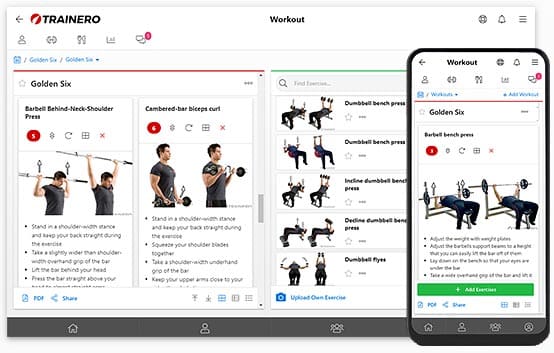
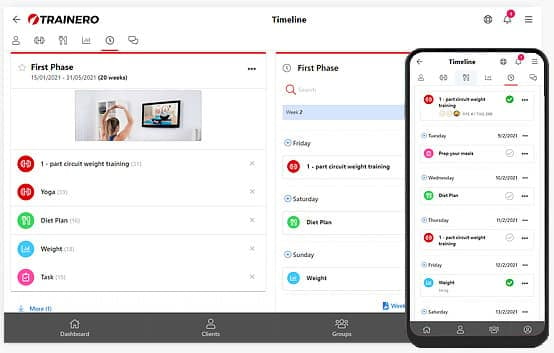
Use AI-assisted tools to generate baseline programme templates, then apply your expertise to customise them for each client’s specific needs, injuries, and preferences. This lets you spend less time building spreadsheets and more time coaching. Using a workout builder software can significantly streamline this process.
Platforms like Trainero are integrating intelligent features that help trainers design programmes faster without removing the trainer’s professional judgment from the process.
2. Enhance Client Communication Between Sessions
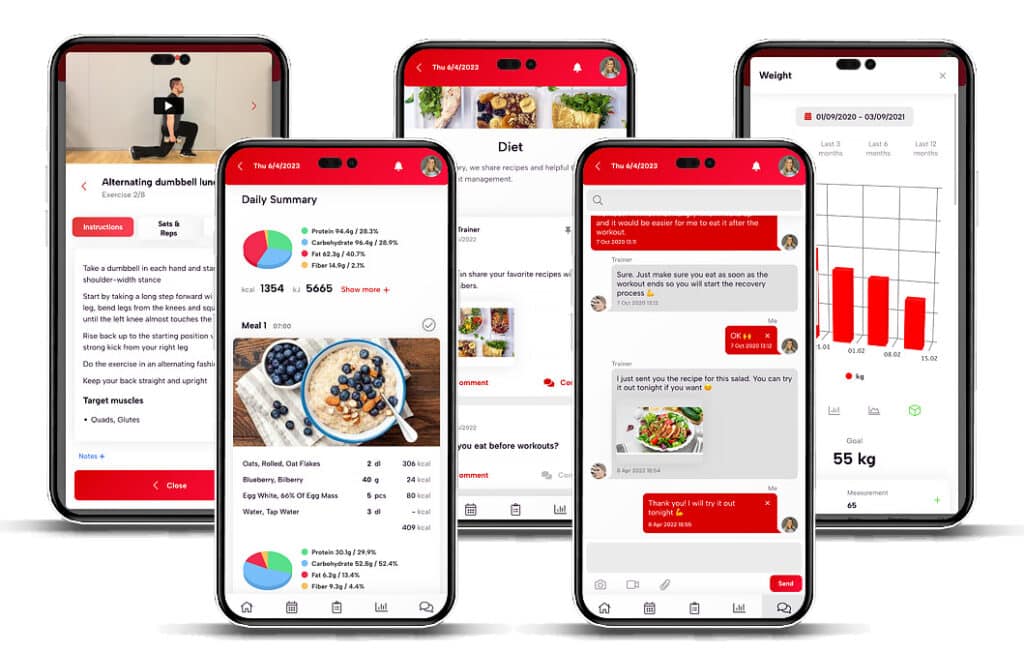
AI-powered check-ins can handle routine questions (“What should I eat before my morning workout?”) while you focus on the high-value interactions that require your expertise. This creates a perception of constant availability without burning you out.
3. Use Data Analytics for Better Results
AI tools can analyse client training data and spot patterns you might miss: plateaus forming, recovery issues, or compliance trends. Use these insights to have more impactful check-in conversations and proactive programme adjustments.
4. Scale Your Business with Hybrid Coaching
Offer a tiered service model:
- Premium tier: Full 1:1 coaching with in-person sessions (your highest-value offering)
- Mid tier: Online coaching with AI-assisted programme delivery and weekly video check-ins
- Entry tier: AI-generated programmes with monthly trainer review and adjustments
This approach lets you serve 3–5x more clients without proportionally increasing your workload.
5. Content Creation and Marketing
Use AI to help draft social media posts, blog content, and email newsletters. AI handles the first draft; you add your voice, expertise, and personal stories. This keeps your marketing consistent without consuming hours of your week.
AI Personal Trainer Apps: What’s Available in 2026
Understanding the competitive landscape helps you articulate your value proposition to potential clients. Here are the main categories of AI fitness tools your clients might be using — or asking about:
- FitnessAI: Uses machine learning trained on 5.9 million workouts to optimise sets, reps, and weight. Popular for strength training.
- Freeletics: AI-powered bodyweight and gym training with adaptive difficulty. Strong in the European market.
- GymStreak: Algorithm-based personal trainer that adjusts workouts based on logged performance.
- ChatGPT / Gemini / Claude: General-purpose AI that can generate workout plans on demand. Free or low-cost but lacks fitness-specific programming logic.
- Zing AI: Conversational AI fitness coach available on mobile platforms.
What they all have in common: None of them can replace the assessment, accountability, relationship, and real-time adaptation that a qualified personal trainer provides.
The Future of AI in Personal Training
AI in fitness will continue to evolve. Here’s what the next 2–3 years likely hold:
- Computer vision for form analysis: Phone cameras analysing exercise form in real-time will improve, but still won’t match a trained eye for subtle dysfunction patterns.
- Wearable integration: AI systems will pull heart rate, HRV, sleep, and recovery data from wearables to auto-adjust training intensity. Trainers who understand this data will add enormous value.
- Voice-coached workouts: AI coaches that guide workouts through earbuds with real-time cues. Think audiobook-style training sessions.
- Predictive analytics: AI will get better at predicting injury risk, plateau timing, and optimal deload periods based on accumulated data.
For personal trainers, each of these developments is an opportunity to upskill and differentiate. The trainers who understand AI tools and can explain their limitations to clients will be seen as more credible, not less relevant.

How to Talk to Clients About AI Fitness Tools
When clients ask “Can’t I just use an AI trainer?” — and they will — here’s how to respond with confidence rather than defensiveness:
- Acknowledge AI’s strengths: “AI tools are great for generating basic workout templates and tracking data. I actually use some of these tools in my own practice.”
- Highlight what’s missing: “What AI can’t do is watch your squat and see that your left hip drops, or know that you’re stressed about work and need a lighter session today.”
- Position yourself as the premium option: “Think of it like tax software vs. a chartered accountant. TurboTax works for simple returns, but when things get complex, you want a professional.”
- Offer proof: “Let me do a movement assessment. I’ll show you three things about your body that no app would ever catch.”
Building Your AI-Enhanced Coaching Practice
Here’s a practical action plan for integrating AI into your personal training business:
- Audit your time: Track where you spend hours on tasks AI could assist with (programme writing, scheduling, basic client questions).
- Choose the right platform: Use professional coaching software like Trainero that gives you AI-powered efficiency while keeping you in control of the client relationship.
- Create a tiered offering: Design service levels that use AI assistance for scalable tiers and pure human coaching for premium tiers.
- Upskill in data literacy: Learn to read and interpret wearable data, training analytics, and recovery metrics. This makes you the expert interpreter AI data needs.
- Communicate your value: Update your marketing to address AI directly. Position yourself as a trainer who uses technology to deliver better results — not one who’s threatened by it.
The Bottom Line
AI personal trainers are here to stay, and they’ll continue getting better. But better AI doesn’t mean less need for human coaches — it means the bar is higher for what clients expect from paid coaching.
The personal trainers who will struggle are the ones who offer nothing more than what an app can do: generic programmes, rep counting, and exercise selection. The ones who will thrive are those who combine human expertise with AI-powered tools to deliver results that no algorithm can match on its own.
Your expertise in movement assessment, behaviour change, motivation, and personalised coaching is more valuable in the AI age, not less. The key is to embrace AI as your assistant, not fear it as your replacement.
Ready to build an AI-enhanced coaching practice? Trainero gives personal trainers the professional tools to deliver exceptional coaching at scale — combining the efficiency of technology with the irreplaceable value of human expertise. Start your free trial today.

Unlock your fitness potential with Trainero! Get a 14-day free trial and access personalized workout plans, expert coaching, and progress tracking—all in one app. No commitments, just results. Start your free trial today and take your fitness journey to the next level!