
As personal trainers, we often get caught up in the latest training trends, advanced periodization models, and cutting-edge exercise variations. But beneath every successful training program lies a fundamental biological principle that has guided athletic development for decades: supercompensation.
Whether you’re working with elite athletes or helping beginners transform their lives, understanding supercompensation isn’t optional. It’s the bedrock upon which all effective programming is built.

What Is Supercompensation?
Supercompensation is the body’s adaptive response to training stress. When you subject the body to a training stimulus that disrupts homeostasis, it doesn’t simply return to its previous state during recovery. Instead, it rebuilds itself slightly stronger than before, preparing for similar future demands.
This principle was first described by Soviet sports scientist Nikolai Yakovlev in the 1950s and remains one of the most important concepts in exercise physiology.
The process follows a predictable four-phase pattern:
- Training stimulus – The workout creates controlled damage and depletes energy stores
- Recovery phase – The body repairs damage and replenishes resources
- Supercompensation window – Performance capacity temporarily exceeds baseline levels
- Detraining – Without new stimulus, fitness returns to baseline (or below)
Why This Matters for Your Coaching Practice
Here’s the critical insight: the supercompensation window is temporary. Time your next training session correctly, and your client builds upon their elevated fitness level. Time it poorly, and you either waste the adaptation or, worse, drive them into overtraining.
This is where many training programs fail. Not because of exercise selection or set-rep schemes, but because of fundamental timing errors.
Training Too Soon
When clients train before adequate recovery, they interrupt the supercompensation process. Each session starts from a slightly depleted state rather than an elevated one. Over weeks and months, this leads to accumulated fatigue, plateaus, and eventually overtraining syndrome.
Signs you might be programming sessions too close together:
- Declining performance despite consistent effort
- Persistent muscle soreness that doesn’t resolve
- Decreased motivation and training enthusiasm
- Sleep disturbances and mood changes
- Increased injury frequency
Training Too Late
Conversely, waiting too long between sessions means missing the supercompensation window entirely. Your client’s elevated fitness level fades back to baseline, and each workout essentially starts from scratch. Progress becomes frustratingly slow despite hard work.
Signs of excessive recovery time:
- Stagnant progress over extended periods
- No performance improvements week to week
- Client feels “too fresh” at every session
- Adaptation seems slower than expected

Practical Application: Finding the Sweet Spot
The challenge is that supercompensation timing varies based on multiple factors:
Training variable – Different qualities have different recovery timelines:
- Neuromuscular power: 24-72 hours
- Muscular strength: 48-96 hours
- Muscular endurance: 24-48 hours
- Cardiovascular endurance: 24-72 hours
Individual factors – Your client’s recovery capacity depends on:
- Training age and experience level
- Sleep quality and quantity
- Nutritional status
- Life stress and work demands
- Age and hormonal status
- Genetics
Session intensity and volume – A light technique session requires far less recovery than a maximal strength test or high-volume hypertrophy workout.
Building Supercompensation Into Your Programming
Effective program design means strategically timing training stimuli to consistently hit supercompensation windows. Here’s how to apply this in practice:
Monitor Recovery Indicators
Teach your clients to track simple recovery markers:
- Morning resting heart rate (elevation suggests incomplete recovery)
- Subjective energy and motivation levels
- Sleep quality ratings
- Muscle soreness scores
- Grip strength (a surprisingly reliable recovery indicator)
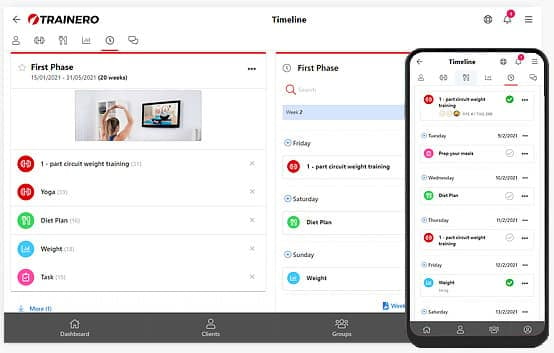
Many personal trainer software platforms allow you to track these metrics alongside training data, making pattern recognition easier.
Use Flexible Programming
Rather than rigid schedules, consider building in flexibility based on recovery status. If a client shows signs of incomplete recovery, a lighter session or additional rest day preserves long-term progress better than pushing through a planned workout.
Periodize Intelligently
Periodization models exist precisely because of supercompensation. By varying training stress across microcycles, mesocycles, and macrocycles, you can manage fatigue accumulation while maintaining progressive overload.
The classic approach:
- Loading weeks – Progressively increasing stress to drive adaptation
- Deload weeks – Reduced volume/intensity allowing supercompensation to fully manifest
Communicate the Why
Clients who understand supercompensation become better partners in their own training. When they grasp why rest days matter and how recovery supports progress, compliance improves dramatically.
Common Programming Mistakes to Avoid
Treating all clients identically – A 25-year-old athlete and a 55-year-old desk worker have vastly different recovery capacities. Program accordingly.
Ignoring life stress – Work deadlines, family issues, and poor sleep all impact recovery. The body doesn’t distinguish between training stress and life stress.
Chasing soreness – Muscle soreness is a poor indicator of training effectiveness. Don’t equate “destroyed” with “productive.”
Neglecting nutrition and sleep – The best-designed program fails without adequate fuel and rest for recovery processes. The science of rest days shows that recovery is the secret to fitness progress.
Following cookie-cutter templates – Pre-made programs can’t account for individual supercompensation timelines. Use them as starting points, not rigid prescriptions.
The Bottom Line
Supercompensation isn’t an advanced concept. It’s foundational. Every time you design a training week, select session frequencies, or decide whether to push a client harder or pull back, you’re making decisions that either work with or against this biological principle.
The best personal trainers don’t just know exercises. They understand adaptation. They recognize that progress happens during recovery, not during the workout itself. And they design programs that respect the body’s need to rebuild stronger.
Master supercompensation, and you master the foundation that makes everything else in training actually work.

Unlock your fitness potential with Trainero! Get a 14-day free trial and access personalized workout plans, expert coaching, and progress tracking—all in one app. No commitments, just results. Start your free trial today and take your fitness journey to the next level!