How to Create Nutrition Plans for Your Personal Training Clients

You can write the best training program in the world, and it’ll still underperform if your client’s nutrition is a mess. Most trainers know this intuitively — you’ve seen the client who trains four times a week and barely changes, and you’ve seen the one who trains three times but eats intelligently and transforms completely. The difference is almost always on the plate, not in the gym.
Turning a plan into meals clients actually buy is easier with a healthy grocery shopping list; for the energy target, see understanding macronutrients.
Yet nutrition planning is where many personal trainers feel least confident. The science feels more complex than exercise programming. The scope-of-practice questions add uncertainty. And the sheer variety of dietary preferences, restrictions, and lifestyles among your clients makes it hard to develop a repeatable system.
Here’s the thing though: creating effective nutrition plans for clients doesn’t require a dietetics degree. It requires a solid understanding of the fundamentals, a practical framework for applying them, and the right tools to deliver the plan in a way clients will actually follow.
Let’s build that framework.
A Quick Note on Scope of Practice
Before we get into the how, let’s address the elephant in the room. In most jurisdictions, personal trainers can provide general nutrition guidance — helping clients understand macronutrients, suggesting meal structures, recommending portion sizes, and creating general meal plans aimed at fitness goals. What you typically can’t do is prescribe therapeutic diets, treat medical conditions through nutrition, or claim to be a nutritionist or dietitian unless you hold those specific credentials.
The practical line is this: if a client is a generally healthy person looking to lose fat, gain muscle, or improve their energy for training, you’re on solid ground providing nutrition guidance. If they have a medical condition, an eating disorder, or complex dietary needs driven by health issues, refer them to a registered dietitian and collaborate with that professional on the fitness side.
Most of your clients fall into the first category. So let’s focus there.
Step 1: Assess the Person, Not Just the Numbers
Just like training programming, good nutrition planning starts with understanding the individual. And that means going deeper than height, weight, and goal.
The obvious data points matter: age, current weight, height, body composition if you can measure it, activity level (including both training and general daily movement), and primary goals. You need these to calculate caloric targets.
But the data that actually determines whether a plan gets followed is different. You need to know what their typical day looks like — when they wake up, when they work, when they can realistically prepare and eat food. You need to know their cooking skills and equipment. Someone with a fully stocked kitchen and a love of cooking can follow a very different plan than someone who lives on a microwave and a toaster.
You need to understand their food preferences, cultural dietary patterns, and any foods they genuinely dislike or can’t eat. A technically perfect meal plan that prescribes foods your client hates is a technically perfect plan that will end up ignored by Thursday.
Budget matters too. Suggesting wild-caught salmon and organic avocados four times a week doesn’t land the same way for a student as it does for a corporate executive. Good nutrition doesn’t have to be expensive, but the plan needs to reflect the client’s financial reality.
A structured intake questionnaire — delivered through your coaching platform — is the most efficient way to collect this information consistently. It ensures you don’t forget to ask important questions, and it gives the client time to think through their answers rather than being put on the spot in a session.
Step 2: Calculate Caloric Targets
With your client’s data in hand, you can establish their caloric targets. The process is straightforward, even if the precision is inherently imperfect — all calorie calculations are estimates, and that’s fine. They give you a starting point to refine based on real-world results.
Calculate Basal Metabolic Rate (BMR). The Mifflin-St Jeor equation is the most widely used and reasonably accurate for most people. For men: (10 × weight in kg) + (6.25 × height in cm) – (5 × age) + 5. For women: (10 × weight in kg) + (6.25 × height in cm) – (5 × age) – 161.
Apply an activity multiplier. Multiply the BMR by an activity factor to estimate Total Daily Energy Expenditure (TDEE). Sedentary (desk job, little exercise): 1.2. Lightly active (light exercise 1-3 days): 1.375. Moderately active (moderate exercise 3-5 days): 1.55. Very active (hard exercise 6-7 days): 1.725. These multipliers are rough guides — err on the conservative side and adjust based on what actually happens over the first few weeks.
Apply goal-based adjustments. For fat loss, a deficit of 15-25% below TDEE is a sustainable range — aggressive enough to produce visible results, moderate enough to preserve muscle and avoid the misery that leads to quitting. For muscle gain, a surplus of 10-15% above TDEE provides the extra energy for growth without excessive fat accumulation. For maintenance or recomposition, stay at or near TDEE.
Step 3: Set Macronutrient Targets
Once you have a calorie target, distribute those calories across the three macronutrients. This is where a lot of trainers overcomplicate things, but the principles are actually quite simple.
Protein comes first. It’s the most important macronutrient for body composition, regardless of whether the goal is fat loss or muscle gain. Aim for 1.6-2.2 grams per kilogram of body weight for most active clients. During a caloric deficit, push toward the higher end to protect muscle mass. Protein has four calories per gram.
Fat comes second. Dietary fat is essential for hormone production, nutrient absorption, and general health. Set a minimum of about 0.7-1.0 grams per kilogram of body weight. Going below this consistently can cause hormonal disruptions, especially in women. Fat has nine calories per gram.
Carbohydrates fill the remainder. Once protein and fat calories are accounted for, the remaining calories go to carbohydrates. Carbs have four calories per gram. For active clients who train hard, this generally works out to a reasonable carb intake that supports training performance and recovery. There’s no need to go low-carb unless the client specifically prefers it — carbohydrates fuel intense exercise, and most of your clients train intensely.
Here’s a practical example. An 80 kg male client aiming for fat loss with a 2,200-calorie target might get: protein at 2g/kg = 160g (640 calories), fat at 0.8g/kg = 64g (576 calories), carbohydrates from the remaining 984 calories = 246g. That’s a perfectly workable starting point that you refine based on his adherence, energy levels, and progress.
Step 4: Build the Actual Meal Plan
This is where theory meets reality, and where many trainers lose their clients. A plan that hits the macros perfectly but doesn’t fit the client’s life is a bad plan. Period.
Decide on the approach. There’s a spectrum between rigid meal plans (eat these exact foods at these exact times) and flexible macro targets (hit these numbers however you want). Most clients do best somewhere in the middle — a structured meal template with built-in flexibility.
For example, you might provide a daily structure: breakfast, lunch, dinner, and two snacks. For each meal slot, give two or three options that hit approximately the right macros. This gives the client variety and choice while keeping them within the nutritional framework. If Monday’s lunch can be grilled chicken with rice and vegetables or a tuna salad with whole grain bread, the client feels autonomous rather than restricted.
Consider meal timing around training. While total daily intake matters more than timing for most goals, there are practical benefits to placing a carbohydrate-rich meal before training (for energy) and a protein-rich meal after (for recovery). Don’t make this overly complicated — “eat a decent meal with protein and carbs a couple hours before you train, and another one reasonably soon after” covers it for most people.
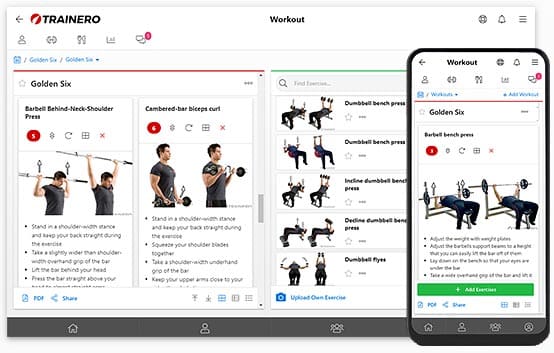
Make the plan visually clear and accessible. This is where your coaching platform earns its keep. A nutrition plan delivered through an app — where the client can see each day’s meals, tap for details, and log what they actually ate — is infinitely more usable than a spreadsheet emailed as an attachment. In Trainero, you build nutrition plans using a comprehensive food database that’s available in 38 languages, and the plan appears right alongside the client’s workout program in their app. Everything in one place, easy to follow.
Step 5: Monitor, Adjust, Repeat
No nutrition plan survives first contact with reality unchanged. The initial plan is your best-educated starting point, not the finished product.
Schedule regular check-ins — weekly for the first month, then biweekly once things stabilize. At each check-in, you’re looking at three things: adherence (are they actually following the plan?), results (is their body composition moving in the right direction?), and sustainability (can they maintain this long-term without feeling miserable?).
If a client isn’t following the plan, the plan is usually the problem — not the client. Maybe the portions are unrealistic for their appetite. Maybe a specific meal is impractical for their schedule. Maybe they simply hate quinoa and you prescribed it three times a week. Adjust the plan to fit their life better rather than lecturing them about discipline.
If they’re following the plan but not seeing results after two to three weeks, the numbers need adjustment. Weight not dropping? Reduce calories by 10-15%. Not gaining? Increase by a similar amount. These adjustments should be small and methodical — wild swings in caloric intake create confusion and undermine trust in the process.
Body measurements, progress photos, and weigh-in trends (not single data points — weekly averages) are your tools here. A coaching platform that tracks these automatically gives you the data you need at a glance. When your client logs their weight each morning through the app and you can see the weekly trend line, you’re making decisions based on real patterns rather than guesswork.
Making It Efficient at Scale
Creating personalized nutrition plans for twenty or thirty clients sounds overwhelming — but it doesn’t have to be, if you build smart systems.
Create template plans for common client profiles. A fat-loss plan for a moderately active female at 1,600 calories, a muscle-gain plan for an active male at 2,800 calories, a maintenance plan for someone training three days per week. Build each one with good food variety and flexible options. When a new client fits a profile, duplicate the template, adjust the specifics to their individual macros and preferences, and deploy.
Use your platform’s food database. Building meals from a database of foods with pre-calculated nutritional values is dramatically faster than researching and entering everything manually. A platform with a comprehensive, multilingual food database makes this particularly efficient — you’re picking from thousands of foods rather than entering data by hand.
Schedule nutrition plans alongside training programs. Using the Timeline feature in your coaching platform, you can schedule nutrition plan updates to align with training phases. When week five’s training program shifts from a fat-loss to a maintenance phase, the nutrition plan updates automatically at the same time. One setup, automatic delivery.
Automate the check-in prompts. Rather than remembering to message each client about their nutrition every week, schedule automated check-in messages that ask the right questions at the right times. “How did this week’s meals feel? Any recipes that didn’t work for you? How’s your energy during training?” These arrive automatically, and the client’s responses give you what you need to make adjustments efficiently.
Bringing It Together
Nutrition planning for clients doesn’t need to be intimidating. The fundamentals are straightforward: understand the person, calculate appropriate targets, distribute macros sensibly, build a plan that fits their real life, and adjust based on what actually happens. The science is simpler than most people think. The art is in making it sustainable.
The trainers who do this well — who pair excellent programming with thoughtful nutrition guidance — deliver dramatically better results than those who only handle one half of the equation. And with the right coaching platform, delivering nutrition alongside training isn’t additional work. It’s a natural extension of the coaching experience your clients already have.
Your clients hired you to help them change their bodies and their health. The gym is half the battle. The kitchen is the other half. Give them both.
Every nutrition plan starts with an energy target: see how to calculate calorie needs for weight loss or gain.
Need a platform that handles nutrition plans as seamlessly as workout programs? Trainero includes a comprehensive food database in 38 languages, integrated meal planning tools, and automated delivery through the client app. Try it free for 14 days.

Unlock your fitness potential with Trainero! Get a 14-day free trial and access personalized workout plans, expert coaching, and progress tracking—all in one app. No commitments, just results. Start your free trial today and take your fitness journey to the next level!