
Every personal trainer knows the feeling. A client who was crushing their workouts three times a week suddenly goes quiet. Messages go unanswered. Sessions get rescheduled, then cancelled, then simply forgotten. The client who seemed completely committed has vanished without explanation.
If this has happened to you, you are not alone. Research consistently shows that the average personal training client relationship lasts just 3 to 6 months, and trainers can expect to lose up to 50% of their clients annually. That turnover represents more than missed sessions. It is lost revenue, wasted relationship-building, and a constant pressure to replace clients just to maintain your income.
But here is the good news: most client departures are preventable. The trainers who maintain retention rates above 80% are not necessarily better coaches. They are coaches who have built intentional systems around the client experience, from the first interaction to the 100th session and beyond.
This guide breaks down the real reasons clients leave, how to spot the warning signs before they disappear, and the practical retention strategies that keep your coaching business growing sustainably in 2026.

The True Cost of Losing a Client
Before diving into retention strategies, it is worth understanding what client churn actually costs your business. Most trainers think of a lost client as a lost session fee. The real cost is far greater.
Acquiring a new client costs 5 to 10 times more than retaining an existing one. When you factor in the marketing spend, the discovery calls, the onboarding time, and the weeks it takes to build a new coaching relationship, replacing a client who leaves after four months is one of the most expensive things that can happen to your business.
Consider this: a client paying 200 euros per month who stays for 12 months generates 2,400 euros in revenue. If they leave after three months, you lose 1,800 euros and spend additional time and money acquiring their replacement. Multiply that across five or ten clients per year, and the financial impact of poor retention becomes clear.
Even a 5% improvement in retention can increase profitability by 25 to 95%, according to widely cited research in customer retention economics. For personal trainers, the math is simple: keeping clients longer is the single most effective way to grow your income without working more hours.
The 7 Real Reasons Personal Training Clients Quit
Understanding why clients leave is the first step to keeping them. While every situation is unique, the same patterns appear consistently across the industry.
1. They Do Not See or Understand Their Progress
This is the most common reason clients disengage, and it is almost entirely preventable. Many clients expect visible physical changes within weeks. When those changes do not appear as quickly as expected, frustration builds and motivation fades.
The problem is rarely that progress is not happening. It is that progress is not being tracked, communicated, or celebrated effectively. If the only measure of success is the mirror or the scale, most clients will feel like they are failing even when their strength, endurance, mobility, and health markers are improving steadily.
2. The Coaching Relationship Feels Transactional
Nearly 50% of personal training clients who leave report that they did not feel a personal bond with their trainer. They felt like a number on a schedule rather than a person with unique goals, challenges, and motivations.
This does not mean you need to become best friends with every client. It means remembering their daughter’s name, asking about their work stress, noticing when they seem off, and acknowledging their life outside the gym. The human connection is what separates a coach from a workout playlist.
3. Communication Is Inconsistent or One-Directional
Clients who only hear from their trainer during sessions are more likely to disengage between sessions. When there is no check-in, no accountability, and no communication between workouts, the coaching relationship exists only within those 60-minute windows.
The gap between sessions is where motivation dies or grows. Trainers who maintain regular, meaningful contact outside of sessions see significantly higher retention rates than those who only communicate face to face.

4. Life Gets in the Way (And No One Adapts)
Work deadlines, family obligations, travel, illness, financial pressure. Life does not pause for fitness goals. When a client’s circumstances change and their training program does not adapt with them, they feel like the only option is to quit entirely.
The trainers who retain clients through difficult periods are those who proactively offer modified programs, adjusted schedules, or temporary alternatives rather than holding rigidly to the original plan.
5. They Hit Their Initial Goal (And No One Sets a New One)
According to the Personal Trainer Development Center (PTDC), 60% of clients who achieved their fitness goals left because no follow-up plan was offered. They reached their target weight, completed their race, or hit their strength milestone, and then there was nowhere to go.
This is one of the most avoidable causes of churn. A client reaching their goal should be a celebration and a transition point, not an endpoint. Trainers who build goal progression into their coaching process keep clients engaged far longer than those who treat goals as finish lines.
6. They Feel Embarrassed or Ashamed
This is the reason behind most ghosting behavior. A client misses a session, then feels guilty. They skip a week, and the guilt compounds. Eventually, reaching out to the trainer feels more uncomfortable than simply disappearing.
Shame is a powerful disengagement driver, and it thrives in silence. If your coaching environment does not explicitly normalize setbacks, missed sessions, and imperfect consistency, you are creating conditions where ghosting becomes the path of least resistance.
7. The Program Becomes Boring or Repetitive
Even the most effective training program becomes stale over time. If clients feel like they are doing the same workouts month after month with no variation, novelty, or progression, boredom sets in. And bored clients start looking for something more exciting elsewhere.
This does not mean constantly reinventing the wheel. It means periodizing programs thoughtfully, introducing new challenges at the right time, and keeping the training experience engaging enough that clients look forward to their sessions.
How to Spot a Client Who Is About to Leave
Client disengagement rarely happens overnight. There are almost always warning signs in the weeks before a client ghosts or formally cancels. Learning to recognize these signals gives you a window to intervene before it is too late.
Declining session attendance is the most obvious sign. A client who goes from three sessions per week to two, then one, is on a clear trajectory toward zero. Track attendance patterns and flag any client whose frequency drops by 30% or more over two consecutive weeks.
Reduced communication outside of sessions is another early indicator. If a client who used to respond to check-ins within hours now takes days, or stops responding altogether, something has shifted in their engagement level.
Decreased effort during sessions can signal that a client has mentally checked out before physically leaving. When someone who used to push hard starts going through the motions, the emotional connection to their goals may have weakened.
Vague or evasive language about future plans is a subtle but telling sign. Phrases like “we will see how things go” or “I might need to take a break soon” are often the client’s way of testing whether you will fight for the relationship or let them drift away.
Stopped tracking or logging workouts, nutrition, or other metrics they previously engaged with signals a decline in personal investment. When clients stop measuring, they are often preparing to stop caring.
The key is not to panic when you notice these signs, but to respond with genuine curiosity and care. A simple, direct conversation often reveals what is really going on and opens the door to a solution.

Unlock your fitness potential with Trainero! Get a 14-day free trial and access personalized workout plans, expert coaching, and progress tracking—all in one app. No commitments, just results. Start your free trial today and take your fitness journey to the next level!
10 Proven Retention Strategies That Actually Work
1. Build a Structured Onboarding Experience
Client retention starts on day one. Research shows that 87% of members who have a positive onboarding experience remain active after six months, while nearly 50% of new fitness clients drop off within the first 90 days when onboarding is weak.
A strong onboarding process sets clear expectations, establishes communication norms, and builds early trust. It should include a comprehensive lifestyle assessment that goes beyond training history to cover sleep, stress, nutrition, work schedule, and personal motivators. It should clearly explain your coaching process, how and when you communicate, and what the client can expect in their first 30 days. And it should create an early win, something the client can achieve in the first two weeks that builds confidence and momentum.
2. Track and Celebrate Progress Relentlessly
If clients cannot see their progress, they will assume there is none. Build multiple progress markers into your coaching process: strength benchmarks, body measurements, movement quality assessments, energy levels, sleep quality, consistency streaks, and habit compliance.
Review these metrics regularly with your clients. Do not wait for them to ask. Show them how far they have come, even when the changes feel small. A client who can see that their squat has improved by 15 kg over three months, or that they have completed 85% of their planned sessions, has a concrete reason to keep going.
Celebrating milestones does not have to be elaborate. A genuine message acknowledging a personal record, a consistency streak, or a lifestyle improvement can make a client feel seen and valued in a way that keeps them committed.
3. Communicate Between Sessions
The time between sessions is where retention is won or lost. Trainers who maintain regular contact outside of workouts see dramatically higher retention rates because clients feel supported, accountable, and connected to their coach throughout the week.
Effective between-session communication includes weekly check-ins that ask about energy, sleep, stress, and training compliance. It includes timely responses to client messages that show you are available and invested. It includes sharing relevant content, whether an article about their specific goal, a recipe that fits their nutrition plan, or a motivational message that lands at the right moment.
Using a coaching platform like Trainero makes this manageable even with a full client roster. When all your communication, programming, and progress tracking lives in one place, maintaining consistent contact becomes a natural part of your workflow rather than an additional burden.
4. Normalize Setbacks and Make It Safe to Struggle
Ghosting is almost always driven by shame. The most powerful thing you can do to prevent it is to create a coaching environment where imperfection is explicitly welcome.
Tell your clients during onboarding that missed sessions happen and that you would rather hear from them than have them disappear. When a client misses a week, reach out with empathy rather than judgment. Make it clear that your coaching adapts to their real life, not the other way around.
Phrases like “life happened, let us figure out what works this week” are infinitely more effective than “you need to be more consistent.” Clients who feel safe being honest with their trainer do not need to ghost. They can simply tell you what is going on.
5. Set Goals That Evolve
Every client should always have a clear, motivating goal to work toward. When they reach one goal, the next should already be taking shape. This does not mean immediately pushing for more; sometimes the next goal is maintenance, recovery, or exploring a new style of training.
The goal-setting conversation should happen at least quarterly. Ask your clients what they want to achieve in the next 90 days, what their biggest challenges are right now, and what would make their training feel exciting and worthwhile. When clients are co-creating their direction, they are far more invested in the journey.
6. Adapt Programs to Real Life
Rigid programs break when life gets chaotic. Flexible programs bend. The trainers with the best retention are those who proactively adjust programming when a client’s schedule changes, when they are traveling, when they are dealing with stress, or when their priorities shift.
Offering a travel-friendly bodyweight program for a client who is away for two weeks, or reducing session frequency during a stressful work period while maintaining communication, shows the client that you are coaching them as a person, not running them through a template.
7. Create a Sense of Community
Clients who feel connected to a community of like-minded people are significantly more likely to stay. This might mean group challenges, shared leaderboards, community chat groups, or social events that create bonds beyond the one-on-one coaching relationship.
Even for trainers who primarily offer individual coaching, creating opportunities for clients to connect with each other, whether through a private online group, a monthly group workout, or a team challenge, adds a social layer that makes the coaching experience stickier.
8. Ask for Feedback (And Act on It)
Many clients who leave never told their trainer what was wrong because they were never asked. Regular feedback collection, whether through informal conversation, quick surveys, or structured check-ins, gives you the intelligence you need to fix problems before they become reasons to leave.
The most important part is acting on the feedback. If a client says they find their program boring, change it. If they say they want more nutritional support, add it. Clients who see their feedback reflected in their coaching experience feel heard and valued.
9. Deliver Value Beyond Workouts
The trainers with the highest retention rates are those who become more than workout designers. They are trusted advisors on sleep, stress management, nutrition, habit building, and overall lifestyle optimization. The more areas of a client’s life your coaching touches, the harder it is to replace you.
This does not mean overstepping your scope of practice. It means positioning yourself as a holistic wellness partner who cares about the client’s overall quality of life. Sharing educational content, providing accountability on lifestyle habits, and connecting the dots between training and life outside the gym all increase your value and deepen the coaching relationship.
10. Make Re-engagement Easy and Shame-Free
Despite your best efforts, some clients will still go quiet. When they do, your response matters enormously. A shame-free re-engagement approach keeps the door open for return rather than closing it permanently.
Send a warm, non-pressuring message after a week of silence. Something like: “Hey, just checking in. No pressure at all, just wanted you to know I am here whenever you are ready. If things have changed or you need to adjust our approach, I am happy to figure that out together.”
If they do not respond, follow up once more after two weeks. After that, respect their space but leave the door clearly open. Many clients who ghost will return weeks or months later if they feel welcome rather than judged. Your consistency in showing up with kindness, even in silence, is what brings them back.
Building Retention Into Your Coaching Platform
The best retention strategies fail if they depend entirely on your memory and manual effort. When you are managing 20, 30, or 50 clients, keeping track of who needs a check-in, whose progress needs reviewing, and who is showing signs of disengagement becomes impossible without the right tools.
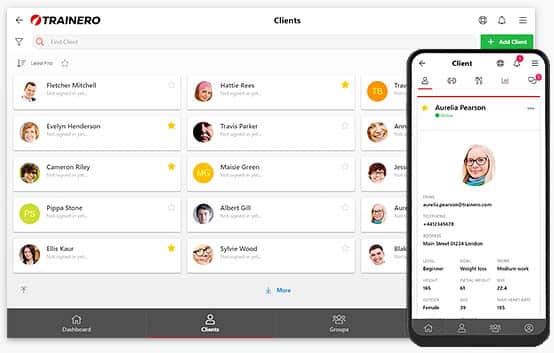
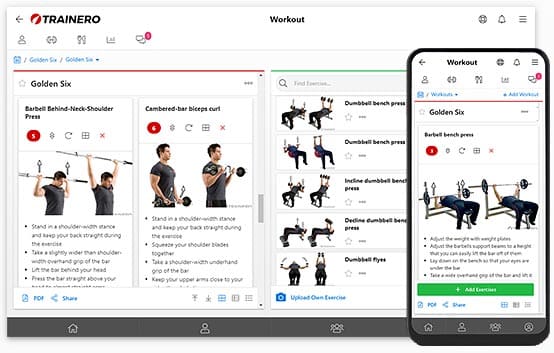
This is where your coaching platform becomes a retention engine. Trainero provides a centralized system where you can manage all your clients, build and share workout and diet plans, create educational content and online courses, communicate directly with clients, and track their engagement and progress, all in one place.
When your entire coaching operation lives in a single platform, nothing falls through the cracks. You can see at a glance which clients have been active, which have gone quiet, and which need your attention. You can share content, adjust programs, and send messages without switching between five different apps. And your clients get a seamless, professional experience that reinforces their confidence in your coaching.
The Retention Mindset: From Acquisition to Relationship
The most profitable personal trainers in 2026 are not the ones with the most impressive marketing funnels or the highest volume of new client inquiries. They are the ones who keep their clients for 12, 18, or 24 months instead of 3 to 6.
Shifting from an acquisition mindset to a retention mindset changes everything about how you run your business. You spend less time and money chasing new leads. Your income becomes predictable and stable. Your clients achieve better results because they stay long enough for real transformation to happen. And those long-term clients become your most powerful marketing channel through referrals and testimonials.
Client retention is not a single tactic or a quick fix. It is a philosophy that runs through every aspect of your coaching: how you onboard, how you communicate, how you program, how you celebrate, how you adapt, and how you respond when things get difficult. Build these systems once, and they will compound in your favor for years to come.
Start Building Your Retention System Today
The strategies in this guide only work if you have the right foundation to support them. Trainero gives personal trainers and fitness coaches everything they need to deliver a professional, engaging coaching experience that keeps clients coming back.
Build customized workout and diet plans. Create online courses and educational content. Manage individual clients and groups. Communicate seamlessly through the platform. Track progress and keep clients engaged at every stage of their journey.
Unlock your fitness potential with Trainero! Get a 14-day free trial and access personalized workout plans, expert coaching, and progress tracking—all in one app. No commitments, just results. Start your free trial today and take your fitness journey to the next level!