
How to Build Trust With Personal Training Clients (No Six-Pack Required)

Nobody hires a personal trainer for the workout plan. Plans are everywhere — free, in apps, on YouTube. What clients are really buying is client trust: the confidence that this person will guide their health honestly and stick around while they do. This guide covers how to build trust with clients as a personal trainer or coach — and why none of it requires a six-pack.
Still wondering about the physique question? Read do you need six-pack abs to be a fitness trainer.
You Don’t Need a Six-Pack to Be a Trusted Coach
Let’s deal with the elephant first. Many coaches quietly believe that their body is their qualification — and that without visible abs, no one will take them seriously. The search data says clients think differently: people don’t look for the leanest trainer, they look for someone they can imagine working with. What clients actually read from you isn’t your body fat percentage. It’s congruence in plain clothes: whether your life rhymes with your advice.
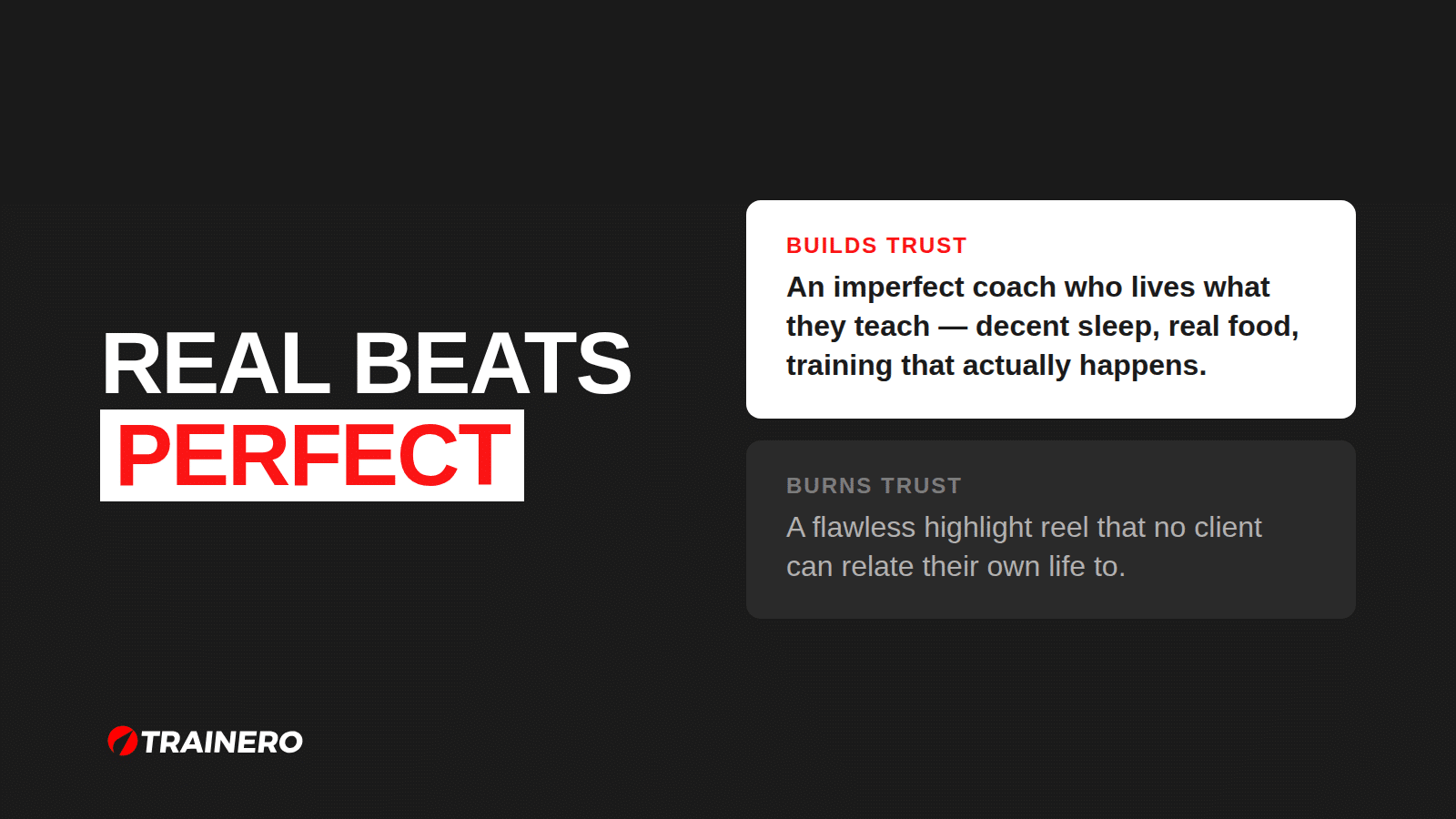
Decent sleep, real food, training you actually do — imperfectly, like a human with a job and a family. An imperfect coach who lives it beats a perfect one who performs it, because clients aren’t looking for proof that perfection exists. They’re looking for proof that the process works for a normal life. Yours is the first case study they’ll ever see.
Trust Is Built in Sentences
Trust rarely turns on big gestures. It turns on small sentences, repeated for months. Here are the ones that build it — and the habits that quietly burn it:
| Builds trust | Burns trust | Why it matters |
|---|---|---|
| “Here’s why this is in your plan.” | “Just trust the process.” | A client who understands the plan follows the plan — and stops doubting it quietly. |
| “I don’t know — I’ll find out by Friday.” | Winging an answer | An honest deadline beats a confident guess. Clients remember which one you gave them. |
| “That’s outside my scope, but I know who to ask.” | Playing physio | Knowing your limits reads as professionalism, not weakness — and protects the client. |
| “How’s that shoulder from last week?” | “Remind me where we left off?” | Remembering the details tells the client they’re a person to you, not a time slot. |
Notice the pattern: every trust-building sentence either explains, commits, or remembers. None of them requires charisma. They’re reps — and like any reps, they compound.
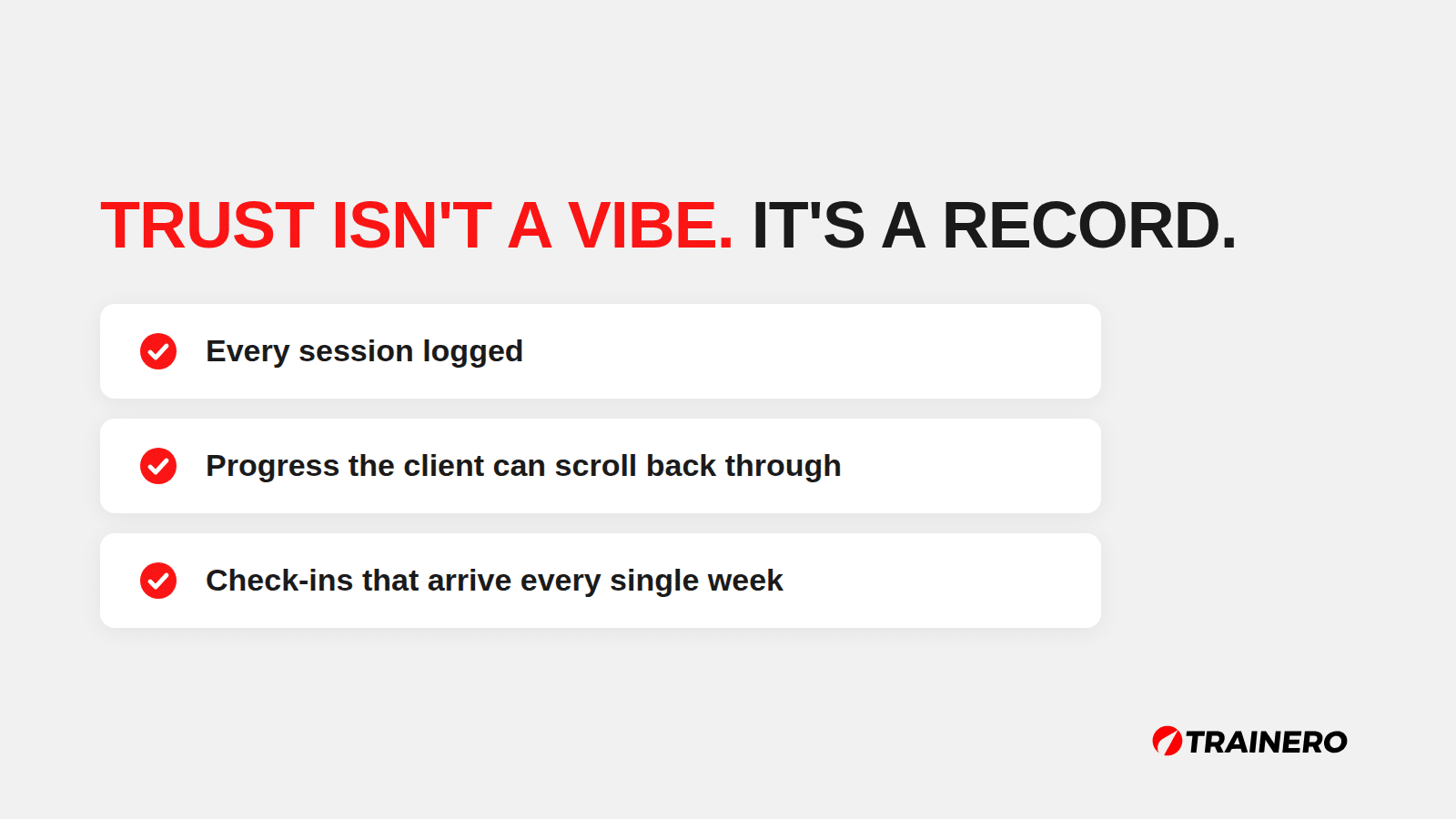
Trust Isn’t a Vibe. It’s a Record.
Here’s the part most trust advice misses: clients trust what they can verify. A warm personality gets you the first month. What earns the sixth month is a record the client can scroll back through:
- Every session logged. The work exists somewhere visible, not just in memory.
- Progress they can see. Weights, measurements, photos, milestones — evidence that the plan is doing something.
- Check-ins that arrive every single week. Not when you remember. Every week. Reliability on a schedule is trust made visible.
This is also where client retention is won or lost. When results stall — and they will stall at some point — the client with a visible record sees a temporary plateau in a long upward trend. The client without one sees nothing, feels nothing, and starts browsing other coaches. It’s one of the four profit leaks we covered in where coaching businesses leak revenue, and it’s the most preventable one.
Practically, this means working out of one system instead of a patchwork of WhatsApp, spreadsheets and memory. A coaching platform like Trainero keeps sessions, progress and check-ins in one place both you and the client can see — and if you’re comparing options, our guide to CRM tools for coaches breaks down what actually matters.
Stay Human Online
Trust-building doesn’t stop at the gym door — most future clients meet you on social media first. And in a feed increasingly full of generic, AI-generated fitness content, the most valuable thing on your profile is the thing many coaches keep editing out: you.
Your personality is the one thing no algorithm can copy. The awkward pauses, the bad jokes, the Tuesday you didn’t feel like training either — that’s not unprofessional. That’s the proof there’s a human behind the account, and humans are what people hire. Post your real face, your real voice, and your real clients’ wins (with their permission, always). A slightly rough video of you explaining why you program rest days will out-earn a polished template every time — because trust is the conversion, not the aesthetics.
The First 30 Days: Where Trust Is Won
Most client relationships are decided in the first month. A simple trust plan for onboarding:
| Week | Trust move |
|---|---|
| Week 1 | Explain the why behind every part of the plan. Set the check-in schedule and keep the first one to the minute. |
| Week 2 | Reference something specific from week 1 (“How did the shoulder feel after we changed the grip?”). Log everything. |
| Week 3 | Show the record: first visible progress marker, however small. Admit one thing you’re still figuring out. |
| Week 4 | Review the month together against the log. Adjust the plan openly — and explain why. |
FAQ
Do you have to be in shape to be a trusted personal trainer?
No. You need to visibly live the fundamentals you teach — consistent training, reasonable habits — but clients choose coaches they can relate to and rely on, not the leanest person in the gym. Coaching skill, communication and reliability outweigh aesthetics in every client survey that matters: retention.
How do personal trainers build trust with new clients?
Explain the reasoning behind the program, keep small promises (punctuality, replies, remembered details), log everything so progress is visible, and admit what you don’t know instead of guessing. Trust comes from repetition, not grand gestures — the first 30 days matter most.
Why do clients leave personal trainers?
Rarely because of a bad program. The usual causes are silent doubt (the client never understood the plan), invisible progress (no record to look back on), and inconsistent contact. All three are trust failures before they’re coaching failures — and all three are fixable with explanation, logging and scheduled check-ins.
How often should you check in with coaching clients?
Weekly, on a fixed day, for as long as the client is with you. The exact frequency matters less than the reliability: a check-in that arrives every Friday builds more trust than a longer message that arrives whenever there’s time.
The Bottom Line
Trust is a practice, not a talent. Live what you teach — imperfectly. Explain your why. Keep a record the client can see. Stay human, online and off. None of it requires more certifications, more followers or a six-pack; it requires showing up as yourself, consistently, with receipts.
Want your sessions, progress and weekly check-ins in one place your clients can see? Start a free 14-day Trainero trial.