How to Scale Your Personal Training Business Beyond 1-on-1 Sessions

At some point, every personal trainer has the same uncomfortable realization. You’re booked solid. Your calendar is full. Your clients are happy. And yet, you can’t seem to earn more without working more. You’ve hit the ceiling — not of your ability, but of the one-on-one model itself.
If you are building from scratch, our step-by-step guide on how to start online coaching walks through the whole setup, from offer to first clients.
There are only so many hours in a day, and trading time for money one session at a time puts a hard cap on your income. If you charge $80 per session and deliver 30 sessions a week, you’re at $2,400 — and you’re probably exhausted. Getting to $5,000 or $10,000 a month doesn’t mean doing twice the sessions. It means rethinking how you deliver value.
Scaling isn’t about abandoning one-on-one coaching. For many trainers, those sessions remain the highest-value part of their business. Scaling is about building additional revenue streams around that core — ones that don’t require you to be physically present for every dollar earned.
Here’s how to do it without losing the personal touch that makes your business work.
The Revenue Ceiling You’re Probably Hitting
Let’s be honest about the math. A full-time personal trainer can realistically deliver 25-35 sessions per week before quality starts declining. Factor in cancellations, no-shows, and the time you spend on programming, admin, and marketing, and your effective hourly rate drops significantly below your session price.
The traditional response is to raise your rates — and you absolutely should, if the market supports it. But rate increases alone are incremental. Going from $70 to $90 per session is meaningful, but it doesn’t fundamentally change the equation. You’re still trading hours for dollars.
Real scale comes from a different approach entirely: serving more people without proportionally increasing your time investment. That sounds like a business cliché until you see how it actually works in fitness coaching.
Revenue Stream 1: Group Coaching Programs
Group coaching is the most natural first step beyond one-on-one, because it leverages the skill you already have — coaching — and multiplies its impact.
The economics are straightforward. If one client pays $80 for an individual session, that’s your return for that hour. But if twelve clients each pay $25 for a group session, you’ve earned $300 in the same time slot. Triple the revenue, same amount of your time. The per-person price is lower, which makes the offering accessible to people who can’t afford one-on-one training, and your total revenue per hour goes up substantially.
But group coaching isn’t just about cramming more people into the same space. It works best when it’s designed as a structured program with a clear outcome: a 6-week fat loss challenge, an 8-week strength foundations course, a 12-week marathon preparation program. The time-bound structure creates urgency, the shared goal builds community, and the defined outcome gives participants something concrete to work toward.
Online group coaching scales even further. You’re not limited by the size of a gym floor. A well-run online group program can handle 20, 50, or even 200 participants — because the core content (workouts, nutrition guidance, educational material) is delivered digitally, and your direct involvement focuses on group Q&A calls, community management, and check-ins.
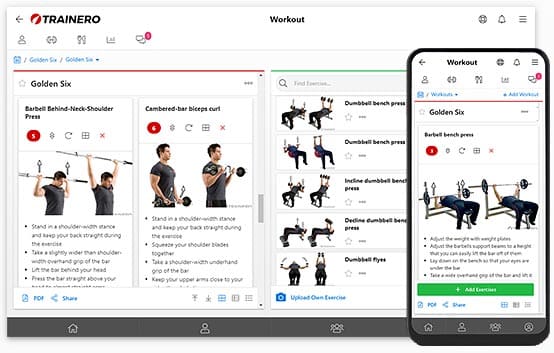
A coaching platform with group management becomes essential here. With Trainero, you can create a Timeline for a group and populate it with workouts, nutrition plans, check-in prompts, videos, and automated messages — the entire coaching experience — and the platform delivers it individually to every participant on schedule. You build it once. Two hundred people experience it as a personal journey.
Revenue Stream 2: Digital Products
Digital products are the closest thing to true passive income in personal training. You create them once, and they generate revenue indefinitely with minimal ongoing effort.
The most common digital products for trainers include pre-built workout programs (a 12-week hypertrophy plan, a home workout series, a mobility routine), nutrition guides, recipe collections, and educational content about specific topics you specialize in. These typically sell for anywhere from $30 to $300, depending on depth and perceived value.
The key to successful digital products is specificity. “A workout plan” doesn’t sell. “An 8-week dumbbell-only muscle building program for people who train at home” does. The more precisely you define who it’s for and what it delivers, the easier it is to market and the more people are willing to pay for it.
Here’s where having a coaching platform with an integrated online store matters enormously. Rather than cobbling together a payment processor, a file delivery system, and an email tool, you can sell programs directly through your app. Trainero’s built-in store lets you list products, process payments, and automatically deliver the content to the buyer’s account — including full access to the workout programs within the app, not just a PDF that gets lost in their downloads folder.
Even better, you can set up automated content activation and deactivation. A 12-week program unlocks when someone buys it and expires after the program window closes. If someone buys a recurring monthly membership, their access continues as long as they pay — and automatically pauses if they don’t. The entire lifecycle is hands-off.
Revenue Stream 3: The Hybrid Model
The hybrid model is arguably the biggest shift in personal training over the past few years, and for good reason. It combines the high-touch connection of in-person sessions with the scalability of digital coaching — and clients actually prefer it.
A typical hybrid package might look like this: two in-person sessions per week, plus a full digital coaching experience between sessions. That includes app-delivered workouts for the days you’re not together, a nutrition plan, messaging access for questions, progress tracking, and regular check-ins. Priced as a monthly subscription, these packages often land between $250 and $500 per month — significantly more than the equivalent number of standalone sessions.
Why does this work so well? Because clients don’t actually want to be left to their own devices on non-training days. They want guidance for the other five or six days of the week too. The hybrid model fills that gap, and the digital component — once set up — doesn’t require proportional time from you.
Think about it this way. Programming a client’s full week in a coaching platform takes maybe 15-20 minutes if you’re building from scratch, or 5-10 minutes if you’re customizing a template. The app handles delivery, logging, and reminders. Your ongoing time investment is reviewing their data and responding to messages — real coaching work, but highly efficient coaching work.
If you serve 30 hybrid clients at $350 per month, that’s $10,500 in monthly revenue — with significantly fewer in-person hours than the equivalent in standalone sessions, and a far better experience for the client.
Revenue Stream 4: Online-Only Coaching
For trainers ready to move fully beyond geographical limitations, online-only coaching opens the door to a global client base. You’re no longer limited to people who live within driving distance of your gym.
Online coaching typically works through tiered subscription packages. A basic tier might offer custom workout programming with monthly check-ins for $100-$150 per month. A mid-tier adds nutrition planning and weekly check-ins for $150-$250. A premium tier provides daily messaging access, video calls, and fully customized everything for $300-$500 or more.
The scalability comes from the asynchronous nature of the work. You’re not delivering live sessions for most of your online clients — you’re delivering programs, reviewing data, and communicating through messages. That’s work you can batch efficiently. Many trainers set aside specific blocks of time each day for online client management and handle 30-50 online clients in a few focused hours.
A strong coaching platform is non-negotiable for online coaching. Your clients need a professional app experience where they can access their programs, track their progress, and communicate with you — not a collection of PDFs and WhatsApp messages. The platform is your gym. If it looks amateur, your coaching looks amateur.
Revenue Stream 5: Building a Team
This is the ultimate scale move, and it’s not for everyone — but for those who have the ambition, building a team of coaches under your brand transforms you from a practitioner into a business owner.
The model is simple in concept: you recruit, train, and manage other coaches who deliver training under your brand. You take a percentage of their revenue in exchange for the client pipeline, brand reputation, systems, and mentorship you provide. Your income becomes a function of your team’s output, not your personal hours.
Practically, this requires a coaching platform that supports multi-trainer workflows. You need the ability to assign clients to specific coaches, control what each coach can see and do, and maintain quality oversight without micromanaging every session. Trainero handles this well — you can add unlimited coaches to your account, assign them to clients and groups, and set granular permissions for each team member. The primary coach maintains full control while each team member works independently through their own login.
A white label app takes this to another level. When your team operates through a branded app with your business name and logo, every client interaction reinforces your brand — not the platform’s. Your coaches are part of your ecosystem, and the client’s loyalty is to your business, not to an individual trainer.
The Systems That Make Scale Possible
Here’s the part nobody tells you: scale doesn’t come from working harder or even working smarter in the moment. It comes from building systems that do the repeatable work for you.
Every revenue stream we’ve discussed depends on having reliable systems for content delivery, communication, progress tracking, and payment processing. Trying to manage group programs through email chains, deliver digital products through file-sharing links, and run hybrid coaching through a patchwork of WhatsApp and Google Sheets doesn’t scale. It just creates a different kind of chaos.
A purpose-built coaching platform centralizes all of this. Your programs, your clients, your communication, your store, your analytics — everything in one place. The automation capabilities — scheduled content delivery, automated payment processing, progress tracking prompts, push notifications — are what make it possible to serve 50 or 100 clients without your workload growing proportionally.
That’s not a luxury. It’s infrastructure. And just like a restaurant can’t scale from 10 covers to 100 without investing in kitchen systems, a personal training business can’t scale without investing in coaching systems.
Where to Start
If you’re currently running a purely one-on-one business, don’t try to launch all five revenue streams at once. Pick the one that fits most naturally with where you are right now.
For most trainers, the hybrid model is the best starting point. Take your existing one-on-one clients and upgrade their experience with digital coaching between sessions. This increases your revenue per client, improves their results, and teaches you how to use a coaching platform effectively — skills you’ll need for everything else.
Once you’re comfortable with that, consider launching a group program or creating your first digital product. Then explore online-only coaching to reach beyond your local market. And if the entrepreneurial bug bites, start thinking about building a team.
Each step builds on the one before it. The clients you coach in person become case studies that sell your online programs. The systems you build for hybrid coaching become the backbone of your group programs. The reputation you develop locally becomes the brand that attracts online clients globally.
The ceiling isn’t your time. It’s your model. Change the model, and the ceiling disappears.
Ready to build a coaching business that scales? Trainero gives you group management, automated content delivery, a built-in online store, multi-coach support, and optional white labeling — everything you need to grow beyond one-on-one. Start your free 14-day trial.

Unlock your fitness potential with Trainero! Get a 14-day free trial and access personalized workout plans, expert coaching, and progress tracking—all in one app. No commitments, just results. Start your free trial today and take your fitness journey to the next level!