How Long to Rest Between Sets: Rest Times by Goal (Chart)
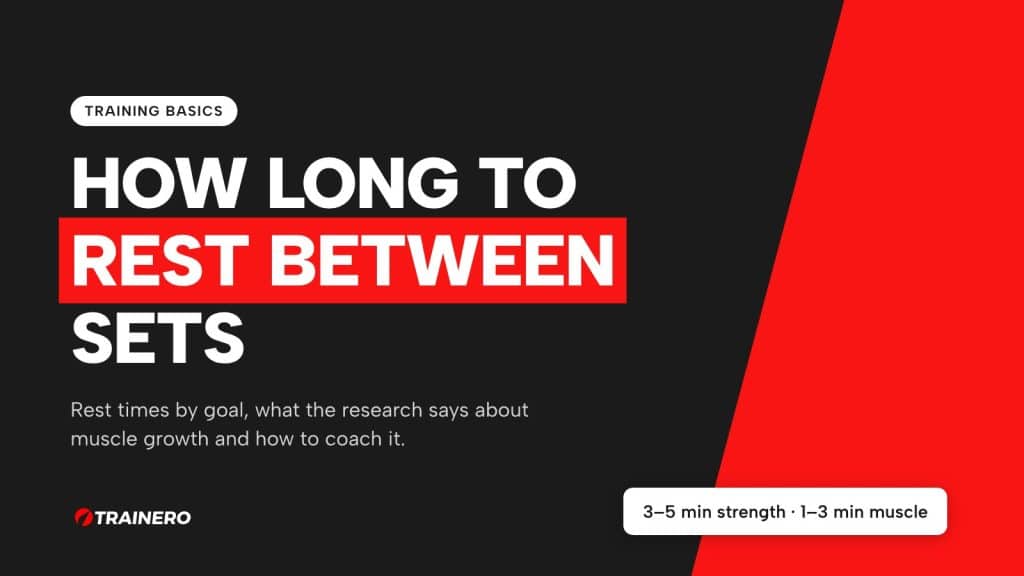
How long should you rest between sets? Rest 3 to 5 minutes between heavy strength sets, 1 to 3 minutes when the goal is muscle growth and under a minute for endurance sets and circuits. Rest is part of the set. Too short and the next set suffers. Too long and the session drags.
This guide gives you a rest time chart by goal, explains what the research says about rest and muscle growth, shows how to tell when you are ready for the next set and covers how coaches can program rest for clients.
Rest between sets by goal (chart)
| Goal | Typical set | Rest between sets | Why |
|---|---|---|---|
| Max strength | 1 to 5 heavy reps on big lifts | 3 to 5 minutes | Near-full recovery keeps the load and bar speed up. |
| Muscle building, compound lifts | 6 to 12 reps | 2 to 3 minutes | Enough rest to hold your reps across all sets. |
| Muscle building, isolation work | 8 to 15 reps | 1 to 2 minutes | Smaller muscles and lighter loads recover faster. |
| Muscular endurance | 15 or more reps, light loads | Under 1 minute | Short rest is part of the training effect. |
| Circuits | Several exercises in a row | None between stations, 1 to 2 minutes between rounds | Keeps the heart rate up and the session short. |
Use the chart as a starting point. The heavier the set and the more muscle it uses, the longer the rest. A set of five heavy squats and a set of fifteen lateral raises do not need the same break.
Why rest time matters
A hard set drains the fast energy your muscles use for short, intense efforts. That store takes a few minutes to refill. If you start the next set before it has, you get fewer reps, you have to drop the weight or your technique slips. Over a whole session that adds up to less quality work.
Resting too long has a cost too. You cool down, lose focus and a 60-minute session turns into 90. The right rest is the shortest one that lets you repeat the quality of the previous set.
How long to rest between sets for strength
For heavy sets of one to five reps on squats, deadlifts, presses and rows, rest three to five minutes. Strength training is practice at producing high force, and you can only practice that when you are fresh. Cutting the rest to save time turns a strength session into a conditioning session with a lighter bar.
Lighter back-off sets and accessory lifts after the main work need less: two to three minutes is usually enough.
How long to rest between sets for muscle growth
For years the standard advice for hypertrophy was 30 to 60 seconds, to “keep the pump”. The research no longer supports rushing.
A 2024 meta-analysis of nine studies on rest intervals and hypertrophy found a small benefit for muscle growth from resting longer than 60 seconds between sets. Beyond about 90 seconds the authors did not find meaningful further differences. The likely reason is simple: with very short rest you cannot do as many reps in the following sets, so the total work drops.
What that means in practice:
- Rest more than a minute on anything you want to grow.
- Take 2 to 3 minutes on compound lifts such as squats, presses, rows and pull-ups. They use a lot of muscle and leave you out of breath, so you need the time to hold your reps.
- Take 1 to 2 minutes on isolation work such as curls, raises and leg extensions.
- Do not rest for the sake of it. If you are ready after 90 seconds, go.
The same idea runs through a good muscle building workout plan: enough rest to keep the sets hard and the reps consistent.
Endurance sets, circuits and supersets
When the goal is muscular endurance or conditioning, short rest is the point. Keep it under a minute for light sets of fifteen or more reps. In a circuit, move straight to the next station and rest one to two minutes between rounds. The same goes for interval formats such as a HIIT workout plan, where work and rest times are fixed in advance.
Supersets are the best way to save time without hurting quality. Pair two exercises that do not compete, such as a press and a row or a leg curl and a calf raise, and rest after the pair. Each muscle still gets its two to three minutes while the other one works.
How to tell when you are ready for the next set
A timer is a guide. These three checks tell you whether the rest was long enough.
- Breathing is calm. You can talk in full sentences.
- Focus is back. Your attention is on the bar, not on the phone.
- Reps will hold. You are confident you can match the last set or get close.
The third check is the one that counts. If your reps fall fast from set to set at the same weight, for example 10, 7 and 5, the rest was too short. If you rate effort with reps in reserve (RIR), you will see the same thing as the RIR dropping faster than planned.
For coaches: how to program rest times
Most clients do not time their rest. They go when they feel like it, which usually means too early on the hard sets and too late everywhere else. Three habits fix most of it.
- Write it down. Put the rest time next to sets and reps when you create the workout plan. “3 x 8, rest 2 min” removes the guesswork.
- Use a timer. A phone timer or a gym clock is enough. It protects the heavy sets from being rushed and stops the long scroll between easy ones.
- Watch the reps. If reps drop fast across sets, add 30 to 60 seconds before you lower the weight.
Rest also changes across a training block. In a deload week the sets are easier, so clients need less rest and sessions get shorter. When the load goes up again through progressive overload, the rest on the main lifts should go up with it.
FOR COACHES
Give every client a program they can follow without you in the room.
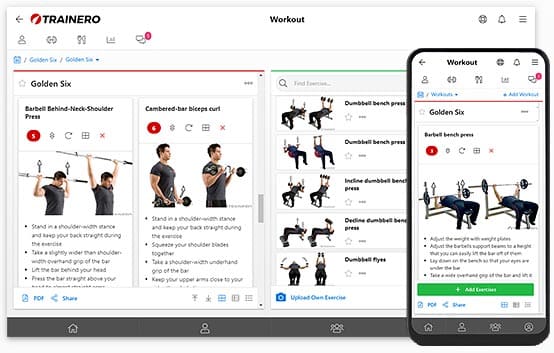
Build it once in the Trainero coach app, assign it to any client or group, and follow their logged results in the client app and with progress tracking.
Frequently asked questions
How long should you rest between sets?
It depends on the goal. Rest 3 to 5 minutes between heavy strength sets of 1 to 5 reps, 2 to 3 minutes on compound lifts for muscle growth, 1 to 2 minutes on isolation exercises and under a minute for light endurance sets and circuits.
Is 1 minute rest between sets enough?
For light isolation exercises and endurance work, yes. For heavy compound lifts it is usually too short, because you lose reps in the following sets. For muscle growth, a 2024 meta-analysis found a small benefit from resting longer than 60 seconds.
Is 5 minutes between sets too long?
Not for heavy strength work. Sets of 1 to 5 reps on squats, deadlifts and presses often need 3 to 5 minutes. For moderate sets and isolation work, 5 minutes is more than you need and mostly makes the session longer.
How long should you rest between exercises?
About the same as between sets, plus the time it takes to set up. Give yourself 2 to 3 minutes before a new heavy compound lift and 1 to 2 minutes before lighter accessory work.
Do longer rest periods make the workout too long?
They can. Save time with supersets: pair two exercises that use different muscles, such as a press and a row, and rest after the pair. Each muscle still recovers while the other one works.
How long should beginners rest between sets?
One to two minutes is enough for most beginner sets, because the loads are still light. Rest longer when breathing is heavy or reps start to drop, and build up to 2 to 3 minutes on the big lifts as the weights get heavier.

Unlock your fitness potential with Trainero! Get a 14-day free trial and access personalized workout plans, expert coaching, and progress tracking—all in one app. No commitments, just results. Start your free trial today and take your fitness journey to the next level!