HIIT Workout Plan: 4-Week Program (Beginner to Advanced)
HIIT (high-intensity interval training) means alternating short bursts of hard effort with recovery periods, for example 30 seconds hard and 60 seconds easy, repeated 6–10 times. The hard intervals push your heart rate close to its maximum, so a 20–25 minute session, warm-up included, can build aerobic fitness in far less time than steady cardio.
This guide gives you a complete 4-week HIIT workout plan: the weekly schedule, three ready-made workouts (bodyweight, cardio machine and strength), beginner-to-advanced versions, and how to keep progressing afterwards. To pace intervals by heart rate, see VO2max and heart rate zones, explained.
What Is HIIT?
HIIT stands for high-intensity interval training. Every HIIT workout has the same three parts:
- Work interval: a short, hard effort, usually 20–60 seconds, at roughly 8–9 out of 10 on the RPE scale, or about 85–95% of your maximum heart rate.
- Recovery interval: easy movement or complete rest, long enough that you can go hard again.
- Rounds: the number of times you repeat the work–recovery pair.
That structure is what separates HIIT from steady cardio, where you hold one moderate pace for 30–60 minutes. Tabata is one well-known HIIT format (20 seconds on, 10 seconds off, eight rounds). Related formats such as EMOM and AMRAP use the same interval idea with strength exercises.
How to Build a HIIT Workout: Work, Rest and Rounds
The work-to-rest ratio decides how hard a session is. Beginners need more rest than work; advanced trainees can work longer than they rest.
| Level | Work | Rest | Ratio | Rounds | Hard time per session |
|---|---|---|---|---|---|
| Beginner | 20–30 s | 60–90 s | 1:3 to 1:2 | 6–8 | 2–4 min |
| Intermediate | 30–40 s | 30–60 s | 1:2 to 1:1 | 8–10 | 4–6 min |
| Advanced | 40–60 s | 20–30 s | 2:1 | 10–12 | 7–12 min |
| Tabata (advanced) | 20 s | 10 s | 2:1 | 8 per block, 2–3 blocks | 5–8 min |
Every session starts with a 5–10 minute warm-up (easy cardio plus a few build-up efforts) and ends with a 5-minute cool-down. The total “hard time” looks small, and that’s the point: if you can keep going for 30 minutes, the intervals weren’t hard enough to count as HIIT.
The 4-Week HIIT Workout Plan
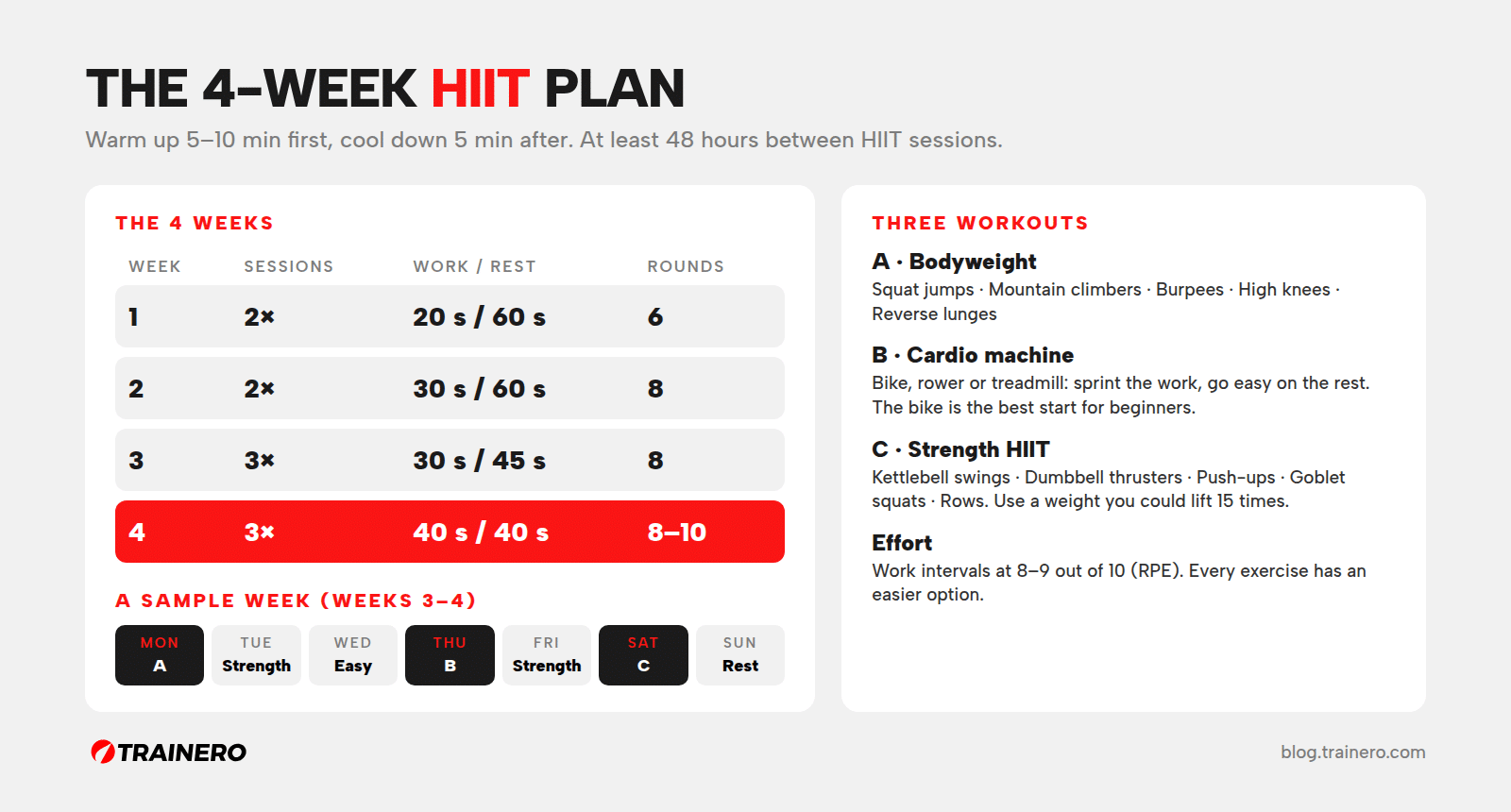
This plan suits anyone who can already exercise moderately for 20–30 minutes. It builds from two to three HIIT sessions a week, always with at least one easier day in between.
| Week | HIIT sessions | Work / rest | Rounds | Workouts |
|---|---|---|---|---|
| Week 1 | 2 | 20 s / 60 s | 6 | A + B |
| Week 2 | 2 | 30 s / 60 s | 8 | A + B |
| Week 3 | 3 | 30 s / 45 s | 8 | A + B + C |
| Week 4 | 3 | 40 s / 40 s | 8–10 | A + B + C |
A sample week (weeks 3–4):
- Monday: Workout A (bodyweight HIIT)
- Tuesday: Strength training
- Wednesday: Rest or an easy 30-minute walk, ride or swim
- Thursday: Workout B (cardio machine intervals)
- Friday: Strength training
- Saturday: Workout C (strength HIIT)
- Sunday: Rest
In weeks 1–2, skip Saturday’s HIIT and keep the rest of the week the same. Leave at least 48 hours between HIIT sessions; the hard intervals only work if you arrive fresh enough to hit them.
Three HIIT Workouts to Use in the Plan
Each round is one work interval and one recovery interval. Cycle through the exercises in order; when you reach the end of the list, start again from the top until you have done all the rounds for that week.
Workout A: Bodyweight HIIT (No Equipment)
- Squat jumps (low-impact option: fast bodyweight squats)
- Mountain climbers
- Burpees (low-impact option: step-back burpees without the jump)
- High knees (low-impact option: fast marching)
- Alternating reverse lunges
Good for home workouts and travel. Keep the landings soft, and slow down the moment your form breaks.
Workout B: Cardio Machine Intervals
Pick one machine and stay on it for the whole session:
- Air bike or spin bike: sprint hard, then pedal easily. The lowest-impact option and the best choice for beginners.
- Rowing machine: drive hard with the legs for the work interval, then row gently.
- Treadmill: run fast, then walk. Change the speed with the controls rather than jumping on and off the side rails of a moving belt; an incline makes the work intervals harder without extra speed.
Machines make it easy to track progress: note your distance or calories per interval and try to beat them next week.
Workout C: Strength HIIT (Dumbbells or Kettlebell)
- Kettlebell swings
- Dumbbell thrusters (squat into overhead press)
- Push-ups (on the knees or hands elevated if needed)
- Goblet squats
- Renegade rows or bent-over dumbbell rows
Choose a load you could lift at least 15 times with good form. Strength HIIT is about moving fast and well, not about maximum weight.
Beginner, Intermediate and Advanced Versions
| Level | Example session | Tips |
|---|---|---|
| Beginner | Workout B on a bike: 20 s hard / 70 s easy × 6 | Use low-impact exercise options and a machine you know. Hard should feel like 7–8 out of 10, not all-out. |
| Intermediate | Workout A: 30 s / 45 s × 8 | Full-impact exercises, shorter rest. Track reps or distance per interval. |
| Advanced | Tabata: 2–3 blocks of 20 s / 10 s × 8, 2 minutes easy between blocks | Only for trainees with solid technique and a strong aerobic base. Genuine Tabata intervals are near-maximal. |
How to Progress After Week 4
After four weeks, keep improving by changing one variable at a time:
- Add rounds (8 → 10 → 12)
- Shorten the rest (40 s → 30 s → 20 s)
- Lengthen the work (40 s → 50 s → 60 s)
- Choose a harder exercise (squats → squat jumps; step-back burpees → full burpees)
Keep HIIT to two or three sessions a week and take an easier week every 4–6 weeks. More HIIT doesn’t mean more results: recovery is when the fitness gains happen. For the programming principles behind this, see the FITT-VP principle.
Does HIIT Burn Fat?
Yes, but less magically than it’s often sold. HIIT burns a lot of energy per minute, and a 2018 meta-analysis of 39 studies (Maillard et al., Sports Medicine) found that HIIT reduced total, abdominal and visceral fat. The famous “afterburn” (EPOC) is real but small, typically a few dozen extra calories rather than hundreds.
What matters most for fat loss is your overall energy balance over weeks and months. HIIT is a time-efficient tool within that, alongside strength training, daily movement and nutrition. Our guide on how to calculate your calorie needs shows how to set that up. And no workout burns fat from one specific area: “spot reduction” doesn’t exist.
HIIT Safety: Who Should Be Careful
- Get medical clearance first if you have a heart condition, high blood pressure, or are returning after a long break, illness or pregnancy.
- Start low-impact (bike, rower, marching and step-back options) if you have knee, hip or back issues, or are new to training.
- Form beats speed. When technique slips, shorten the interval or switch to an easier exercise.
- Stop immediately if you feel chest pain, dizziness or unusual shortness of breath.
Frequently Asked Questions
What is a good HIIT schedule?
Two to three HIIT sessions a week on non-consecutive days, combined with two strength sessions and some easy cardio or walking, works for most people. Beginners should start with two sessions.
Is 20 minutes of HIIT per day enough?
A 20-minute session, including the warm-up and cool-down, is enough for one HIIT workout. Doing it every day is not recommended; alternate HIIT days with strength training, easy cardio or rest.
What are the top 10 HIIT exercises?
Burpees, mountain climbers, squat jumps, jumping lunges, high knees, kettlebell swings, bike sprints, rowing sprints, battle ropes and skater jumps. Pick exercises that use large muscle groups and that you can do with good technique while tired.
Does HIIT burn belly fat?
HIIT can reduce abdominal and visceral fat as part of overall fat loss, but you can’t target belly fat specifically. Consistent training plus a calorie deficit is what reduces fat, including around the waist.
How long should a HIIT workout be?
Most effective HIIT workouts take 15–30 minutes including the warm-up and cool-down, with 4–12 minutes of actual hard work. If you can keep going much longer, the intervals probably aren’t intense enough.
What does HIIT mean in a workout?
HIIT (high-intensity interval training) means the workout alternates short, very hard efforts with recovery periods, instead of training at one steady pace.
Programming HIIT for Clients
If you’re a coach, HIIT is easy to prescribe but hard to track: work and rest times, rounds and perceived effort all matter. With Trainero you can build interval workouts once, assign them to clients, and see their completed rounds and RPE after every session. Looking for more variety? Try these fitness challenge ideas with your clients.

Unlock your fitness potential with Trainero! Get a 14-day free trial and access personalized workout plans, expert coaching, and progress tracking—all in one app. No commitments, just results. Start your free trial today and take your fitness journey to the next level!