
The Motivation Gap: How to Keep New Clients Past Week Three
You know the message. It arrives on a Monday, about three weeks in: “Could we move Tuesday — just this once?” Then the next week it’s a shorter message, and the week after that, the client is gone. Nothing went wrong in the sessions. The programming was fine. The client liked you.
For the complete picture, read our personal training client retention guide: why clients quit, and the systems that keep them training with you.
What went wrong was timing. Around week three, most new clients hit a predictable low point — and most coaches meet it unprepared, because it doesn’t look like a crisis. It looks like a small scheduling request. This guide is about that window: why it happens, the signals that show up first, and the plan you put in place during week one so week three doesn’t cost you a client.
The Motivation Gap: Why Week Three Is the Danger Zone
New clients start with two things working in their favour: novelty and decision energy. They just made a change, everything is unfamiliar in a good way, and showing up feels like progress in itself. Both of those fade on a schedule.
Meanwhile, the thing that would keep them going — visible results — is still weeks away. Strength adaptations are real long before they’re obvious; body composition, energy and sleep changes take longer still. So there’s a stretch, usually in the third or fourth week, where the excitement has run down and the payoff hasn’t landed. Both curves are low at the same time.
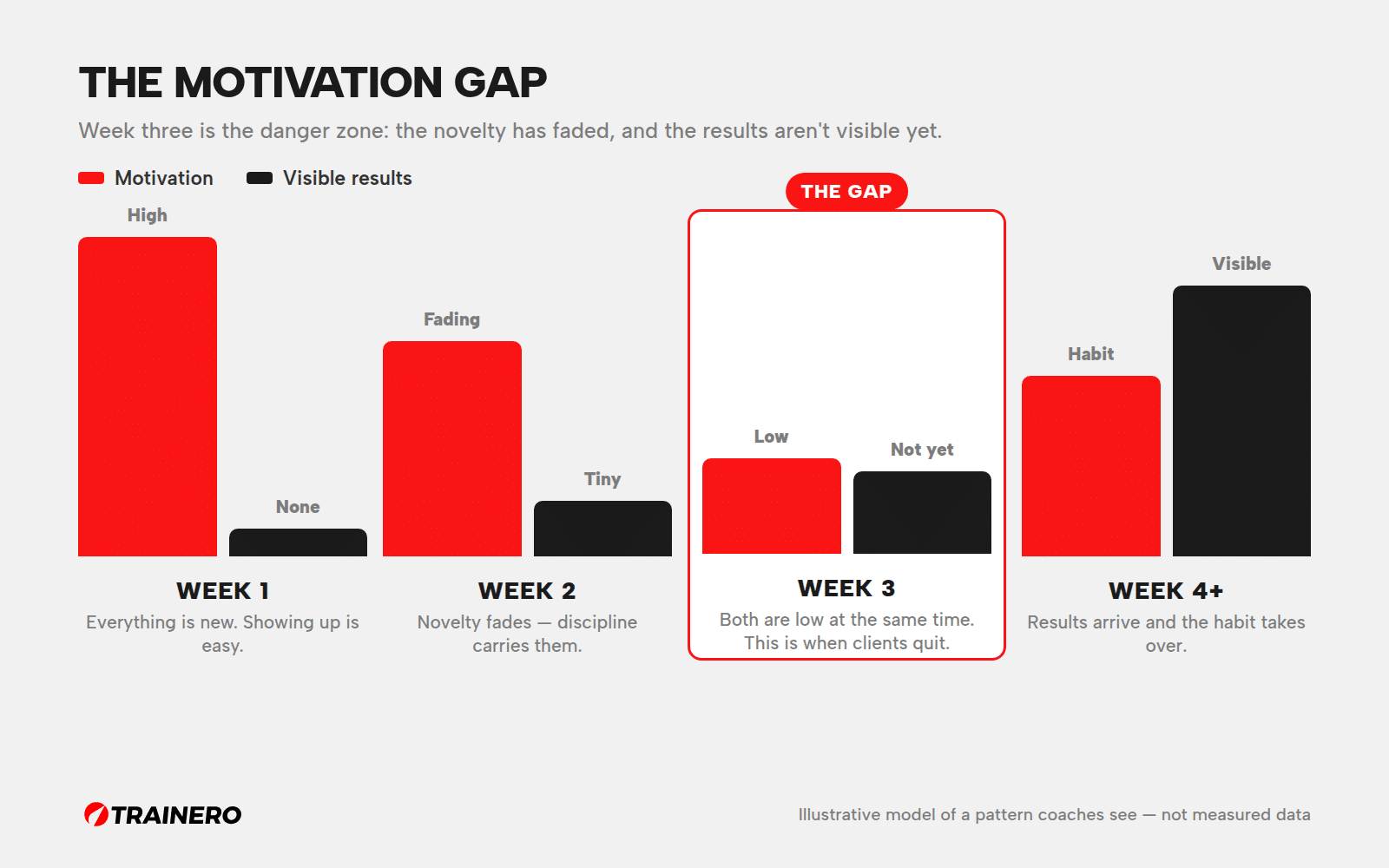
Motivation runs out before results show up. That single sentence explains most early churn, and it reframes the problem usefully: this isn’t a client character flaw, and it isn’t a sign you’re a bad coach. It’s a structural gap in the first month of any behaviour change — which means you can plan around it, the same way you plan a deload.
For tools that make early progress visible, see visual progress tracking with photos and measurements.
It Announces Itself First: The Signals to Watch
Clients almost never cancel out of nowhere. They drift first, and the drift is visible if you’re looking for it. The useful part is the response window: each signal gives you a few days to act before the decision hardens.
| Signal | What it sounds or looks like | Respond within |
|---|---|---|
| The reschedule | “Could we move Tuesday — just this once?” | Same day. Offer a new slot immediately, in the same message. |
| Shorter replies | Paragraphs become a thumbs-up | 2–3 days. Ask one open question that isn’t about training. |
| The quiet log | No training entries, no food entries, no questions | 3 days of silence. Check in before the week ends. |
| The postponement | “I’ll be back when work calms down” | Immediately — this is a cancellation in polite clothing. |
| Negative self-talk | “I’m just not a gym person” / “I always do this” | In the session it happens. Name the pattern, then reframe. |
By the time someone actually cancels, the signals were usually a week old. So the discipline to build is simple: respond to the signal, not the cancellation.
Don’t Fix Week Three. Plan for It in Week One.
Rescue missions are expensive and rarely work; prevention is three conversations that cost you ten minutes total.
1. Name the wobble out loud in session one
Tell every new client, on day one: “Somewhere around week three, this will start to feel pointless. The newness will be gone and you won’t see much in the mirror yet. That’s not you failing — it’s the normal shape of this. When it happens, here’s what we’ll do instead of stopping.” Then say what you’ll do (see the next two moves).
This works for the same reason explaining the reasoning behind each exercise works: a client who understands what’s coming interprets the dip as part of the plan rather than as evidence that it isn’t working. You’ve pre-labelled the experience, so when it arrives, it confirms your expertise instead of undermining it.
2. Measure something that moves early
The scale is the slowest number in the room, and it’s noisy. If it’s the only metric your client watches, week three will look like failure even when training is going well. So pick two or three markers that move within the first weeks and put them in front of them:
Reps at the same load. Weight on the bar. Range of motion in a movement that was restricted. Resting heart rate. Sleep duration. How the third flight of stairs feels. Sessions completed — simply attending four out of four is a win worth naming out loud. Whatever you choose, write it down in week one so you have a baseline to compare against when the doubt arrives.
3. Shrink the week — never pause it
When a client wobbles, the instinct on both sides is to pause: take a couple of weeks, come back when things settle. Pauses sound like rest and function like exits — the habit breaks, the calendar fills, and the return date quietly moves.
Shrink instead. Two sessions instead of four. Thirty minutes instead of sixty. One session plus a twenty-minute home circuit. The programme matters far less than the unbroken thread of showing up, because the thread is what carries them to week four, where results finally start doing the motivating for you.
What to Say Instead
Most retention happens in sentences. These are the three swaps that change the most outcomes:
| Situation | Don’t say | Say |
|---|---|---|
| They’re slipping | “Stay consistent!” | “Let’s do two sessions this week instead of four.” |
| They want results | “The scale will move soon” | “You’ve added 10 kg to your squat in three weeks.” |
| Ending a session | “Let me know if you need anything” | “I’ll check in Thursday — which day looks hardest?” |
| They missed a week | “No worries, start again when you’re ready” | “Let’s get one session in this week. Which day works?” |
| They’re discouraged | “Just trust the process” | “Here’s what changed since week one, and here’s what changes next.” |
Notice the pattern: every replacement is specific, contains a next action, and puts the decision in a smaller frame. “Stay consistent” asks for a personality change. “Two sessions this week” asks for a calendar entry.
The First Six Weeks: A Check-In Calendar
Here’s the whole thing as a schedule you can copy into your calendar or your coaching platform. Nothing here takes more than five minutes, and it’s the same for every new client — which is what makes it a system rather than a good intention.
| When | What you do | What you say |
|---|---|---|
| Week 1, session 1 | Set baselines; name the week-3 wobble | “Around week three this will feel pointless. That’s normal — here’s the plan.” |
| End of week 1 | Short message: acknowledge the start | “Two for two this week. That’s the whole game right now.” |
| Week 2 | Show one early marker moving | “Same weight, two more reps than Monday. That’s real.” |
| Start of week 3 | Proactive check-in — before any signal appears | “This is the week I warned you about. Which day looks hardest?” |
| Week 3, mid-week | Offer the shrink pre-emptively if needed | “Let’s make this week two sessions, not four. We keep the thread.” |
| Week 4 | Progress review against week-1 baselines | “Here’s everything that’s changed in a month.” |
| Week 6 | Reset goals for the next block; ask for feedback | “What’s working, what’s annoying, what should we change?” |
The week-3 check-in is the one that earns its keep. It costs you two minutes and it arrives before the reschedule message — which means you’re the one framing the week, not reacting to it. If you run your client communication through a coaching platform, set these as recurring tasks so they happen whether or not you remember; keeping client history in one place is what makes a check-in feel personal instead of generic.
Make Retention a Number You Watch
Most coaches can tell you how many new clients they signed last month. Far fewer can tell you how many made it past week six — and that second number decides your income. Two simple metrics are enough:
Six-week survival. Of the clients who started six weeks ago, how many are still training with you? Check it monthly. If it’s below two thirds, your problem is onboarding, not marketing.
Attendance rate. Sessions attended divided by sessions booked, per client, per month. This is your early-warning system at the portfolio level: a client sliding from 100% to 60% is in the gap right now, whatever their messages say.
These belong in the “key metrics” box of your business plan — if you haven’t built one, the one-page Lean Canvas for coaches takes about twenty minutes. And it’s worth doing the arithmetic once: keeping three clients an extra three months is usually worth more than winning one new client, and it costs you nothing in ad spend. Retention is the cheapest growth channel you have — cheaper even than being available where people already train.
FAQ
Why do personal training clients quit after a few weeks?
Usually because of timing rather than dissatisfaction. The novelty and decision energy that carried the first sessions fade within two to three weeks, while visible results take longer to arrive. In that gap, stopping feels reasonable — especially if nobody warned them it was coming.
Should I let a client pause their coaching?
Offer a smaller week before you offer a pause. Pauses break the habit and rarely end on schedule. If a genuine life event makes training impossible, agree on a specific return date and a single minimum commitment in the meantime — one short home session a week is enough to keep the thread intact.
How often should I check in with new clients?
Weekly for the first six weeks, with one proactive message at the start of week three. Frequency matters less than predictability: a client who knows your Thursday message is coming will often pre-empt it with what they’re struggling with, which is exactly the conversation you want.
What’s a good client retention rate for a personal trainer?
There’s no universal benchmark worth quoting, because packages, pricing and client types differ too much. Measure your own number instead and improve it: track how many clients pass six weeks and how many pass six months, then compare quarter to quarter. Your own trend line is the only benchmark that tells you anything.
Does this apply to online coaching too?
Even more so. Online clients lack the accountability of a booked appointment with a person waiting, so the gap arrives quieter and earlier. The signals shift to app data — missed logs, unopened programmes — which makes the proactive week-3 message essential rather than optional.
The Bottom Line
Your client will probably want to quit around week three, and it won’t be your programming’s fault — motivation simply runs out before results show up. Name the gap in week one, measure something that moves early, check in before they go quiet, and shrink the week instead of pausing it. Those four habits are the difference between a roster that churns and one that compounds. Trust gets clients through the door; a plan for week three is what keeps them.
Retention is easier when nothing falls through the cracks — programmes, check-ins, progress tracking and client history in one place. Start a free 14-day Trainero trial.