
Lean Canvas for Personal Trainers (+ Free AI Prompt)
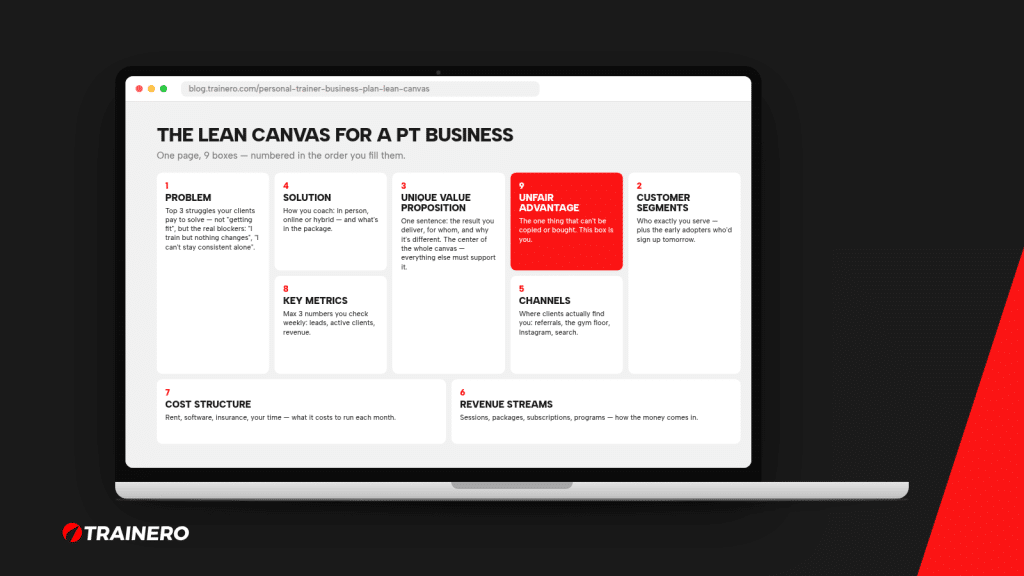
There’s a lively debate about AI in the coaching world right now, and both sides are half right. AI-generated content really is making feeds worse — generic posts in a voice that belongs to nobody. But writing AI off entirely means missing the jobs it’s genuinely good at. Your voice is not one of them. Your business plan is.
Want the full version? Our step-by-step personal trainer business plan guide covers services, pricing, finances and your launch plan.
In this guide: the Lean Canvas — a one-page business plan built for people who will never write a 30-page one — adapted for personal trainers, plus a ready-made AI prompt that interviews you, challenges your answers and fills in the whole canvas with you. Twenty minutes, one page, no jargon.
Why Most Personal Trainer Business Plans Never Get Written
Ask ten coaches for their business plan and you’ll get one PDF, three notebooks and six versions of “it’s all in my head.” That’s not laziness — traditional business plans are built for banks and investors, not for a one-person coaching business that changes month to month. They take weeks to write and are out of date the moment they’re finished.
The result: most coaches run on instinct. Pricing is whatever the gym next door charges, marketing is whatever felt right this week, and the answer to “who exactly do you serve?” is “anyone who pays.” It works — until it doesn’t. When growth stalls, there’s no map to check.
For more ways to use AI in your coaching business, see AI for personal trainers.
The Lean Canvas: A Business Plan You’ll Actually Finish
The Lean Canvas, adapted by Ash Maurya from the Business Model Canvas in his book Running Lean, compresses an entire business model onto a single page with nine boxes. It was designed for startups, but it fits a coaching business unusually well — because a PT business is a startup: one founder, limited hours, and a service that lives or dies on positioning.
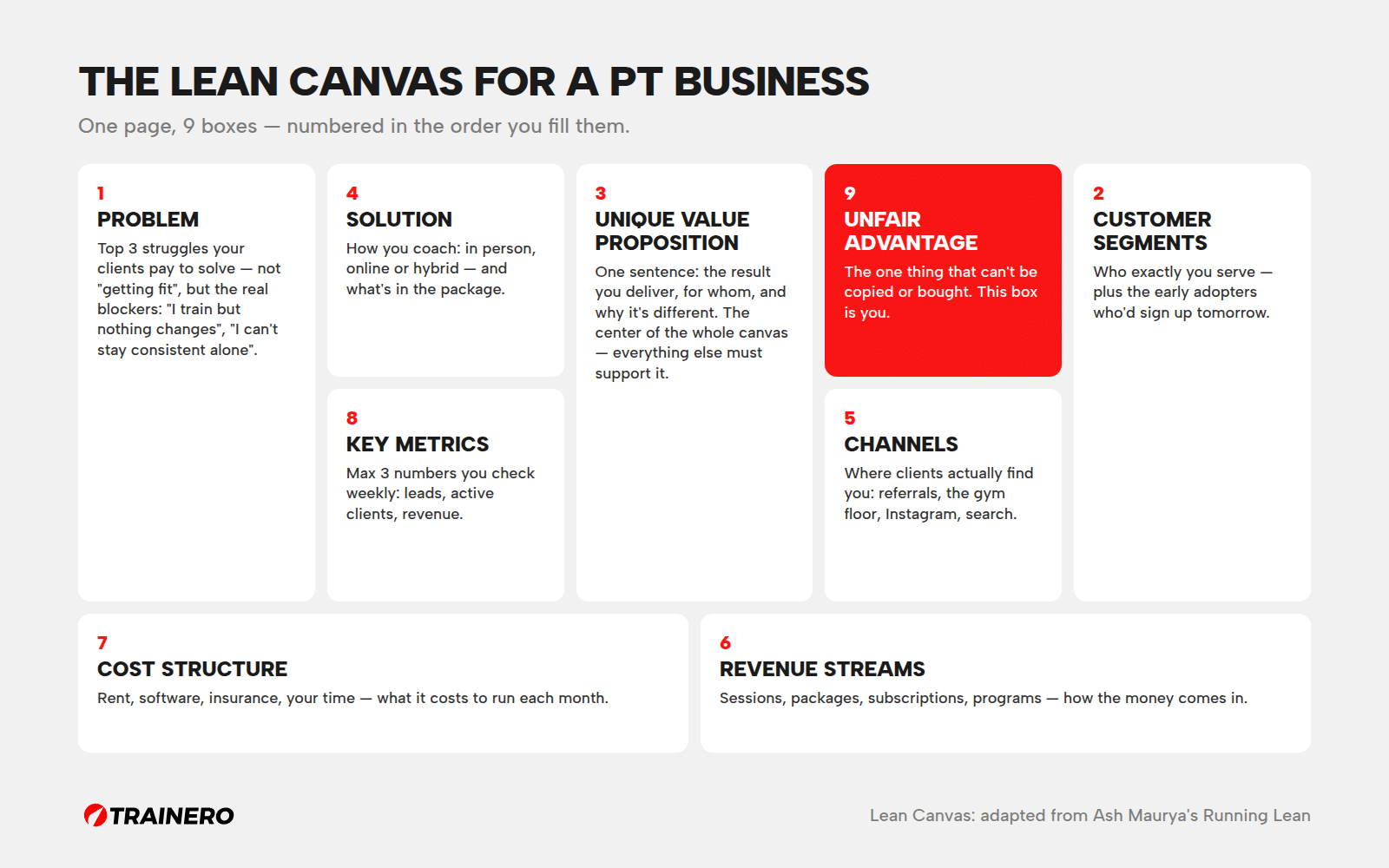
The 9 Boxes, Explained for Coaches
| Box | The question it answers | A PT example |
|---|---|---|
| 1. Problem | What are the top 3 struggles your clients pay to solve? | “I train hard but nothing changes” · “I can’t stay consistent alone” · “I don’t trust generic programs” |
| 2. Customer segments | Who exactly do you serve — and who are your early adopters? | Busy professionals 35–50 who’ve tried and quit twice before |
| 3. Unique value proposition | One sentence: what result, for whom, and why you? | “Strength coaching for desk workers who want to stop restarting every January” |
| 4. Solution | How do you deliver coaching? | Hybrid: 1 in-person session/week + app-based programming and check-ins |
| 5. Channels | Where do clients actually find you? | Client referrals, Instagram, Google search, the gym floor |
| 6. Revenue streams | How does the money come in? | Monthly coaching subscription + self-paced programs in an online store |
| 7. Cost structure | What does it cost to run each month? | Gym rent, coaching software, insurance, ads — and your hours |
| 8. Key metrics | Which 3 numbers do you check weekly? | New leads, active clients, monthly recurring revenue |
| 9. Unfair advantage | What can’t be copied or bought? | Your story, your track record, your community — you |
The AI Prompt That Fills It In With You
You could fill the canvas alone, but the boxes are only as good as the questions behind them — and it’s hard to interrogate yourself. That’s the job we gave AI. Copy the prompt below into ChatGPT, Claude or Gemini. It will interview you one question at a time, push back when your answers are vague, and assemble the canvas from what it learns. Answer honestly; it’s built to dig.
You are an experienced business coach who specializes in fitness and coaching businesses. Your job is to help me — a personal trainer — build a Lean Canvas for my coaching service: my whole business model on one page.

Work like this:

1. Interview me first. Ask me ONE question at a time and wait for my answer before moving on. Cover: who I love coaching most and why; what result those clients actually pay for; what they've tried before that didn't work; how I deliver coaching today (in person, online, hybrid); what I charge and how I'd like to earn (sessions, packages, subscriptions, programs); where my current clients came from; my monthly business costs; and how much time I can invest per week.

2. Push back like a real coach. If my answers are vague ("I help people get fit"), keep digging until they're specific enough that a stranger could repeat them. Challenge assumptions that sound like wishful thinking.

3. Then fill in my Lean Canvas with these 9 boxes: Problem (top 3), Customer Segments (with one early-adopter segment), Unique Value Proposition (give me 3 options to choose from), Solution, Channels, Revenue Streams, Cost Structure, Key Metrics (max 3 numbers I should track weekly), and Unfair Advantage.

4. Leave Unfair Advantage for last — and don't fill it in yourself. Ask me: "What do you have that cannot be copied or bought — your story, your track record, your community, your presence?" Then help me sharpen my answer into one sentence.

5. Finish with a reality check: list the 3 riskiest assumptions in my canvas and, for each one, give me a concrete way to test it within 2 weeks without spending money.

Keep the final canvas compact enough to fit on one page. Format it clearly with the 9 boxes as headings. Be direct, warm and practical — no corporate jargon.
What to Do With the Output
The canvas isn’t the finish line — it’s a list of guesses to test. The prompt ends with your three riskiest assumptions on purpose: spend the next two weeks testing them. If your canvas says busy professionals will pay for hybrid coaching, message five of them this week and find out. If it says Instagram is your channel, check where your last five clients actually came from.
Then make it a habit: revisit the canvas quarterly, and rebuild it during your market’s quiet season — the natural prep window before your busy season hits. If the canvas points you toward recurring revenue and online delivery (it usually does), that’s the moment to build the online side of your business properly: programs, a store and a system that keeps client relationships organized — which is exactly what Trainero handles in one place.
The One Box AI Can’t Fill
Run the prompt and you’ll notice something: the AI fills eight boxes with you, but it has to stop at the ninth. Your unfair advantage — the thing competitors can’t copy or buy — is not something a language model can generate, because it isn’t information. It’s your story, your track record, the way clients feel in your sessions, and the trust you’ve built by being consistently, visibly yourself.
That’s the right division of labor in one sentence: let AI structure your business — never your voice. Use it for the planning nobody sees, and stay stubbornly human everywhere your clients can.
FAQ
Do personal trainers really need a business plan?
If you coach for income, yes — but not a 30-page document. You need clear answers to a handful of questions: who you serve, what they pay for, where they find you, and what you track. The Lean Canvas covers exactly that in one page, which is why it gets finished when traditional plans don’t.
What’s the difference between a Lean Canvas and a business plan?
A traditional business plan is a long, static document written mostly for outsiders like banks. A Lean Canvas is a one-page working tool written for you: nine boxes of assumptions you test and update as you learn. For a solo coaching business, the canvas does everything the long plan would — in a form you’ll actually revisit.
Which AI tool should I use with the prompt?
Any current assistant works — ChatGPT, Claude or Gemini. The prompt matters more than the tool: it forces a one-question-at-a-time interview and tells the AI to challenge vague answers, which is what turns a generic chat into something like a session with a business coach.
How often should I update my Lean Canvas?
Quarterly is a good rhythm, plus whenever something big changes — a pricing overhaul, a move to online coaching, a new client segment. The update takes minutes, not days: rerun the prompt, tell the AI what changed, and let it challenge the boxes that no longer hold.
The Bottom Line
AI isn’t the enemy of authentic coaching — generic is. Keep your voice, your posts and your presence human, and put AI to work on the job most coaches never get to: a business plan that fits on one page and actually gets used. Twenty minutes, nine boxes, three tested assumptions. And the ninth box was never AI’s to fill anyway. It’s you.
When your canvas is done, build it in one place — coaching programs, online store, client management and automated delivery. Start a free 14-day Trainero trial.