
RPE Scale: Rate of Perceived Exertion Chart (1–10 & Borg 6–20)
RPE (rate of perceived exertion) is a scale for rating how hard exercise feels, most often from 1 (very light) to 10 (maximal effort). Instead of measuring heart rate or speed, you rate your own effort: your breathing, muscle fatigue and how much you have left. It works for running, cycling, HIIT and lifting, needs no equipment, and automatically adjusts for bad sleep, stress and good days. Read also our article about RPE protocol and what to consider when training women.
To compare RPE with reps in reserve, see RPE vs RIR.
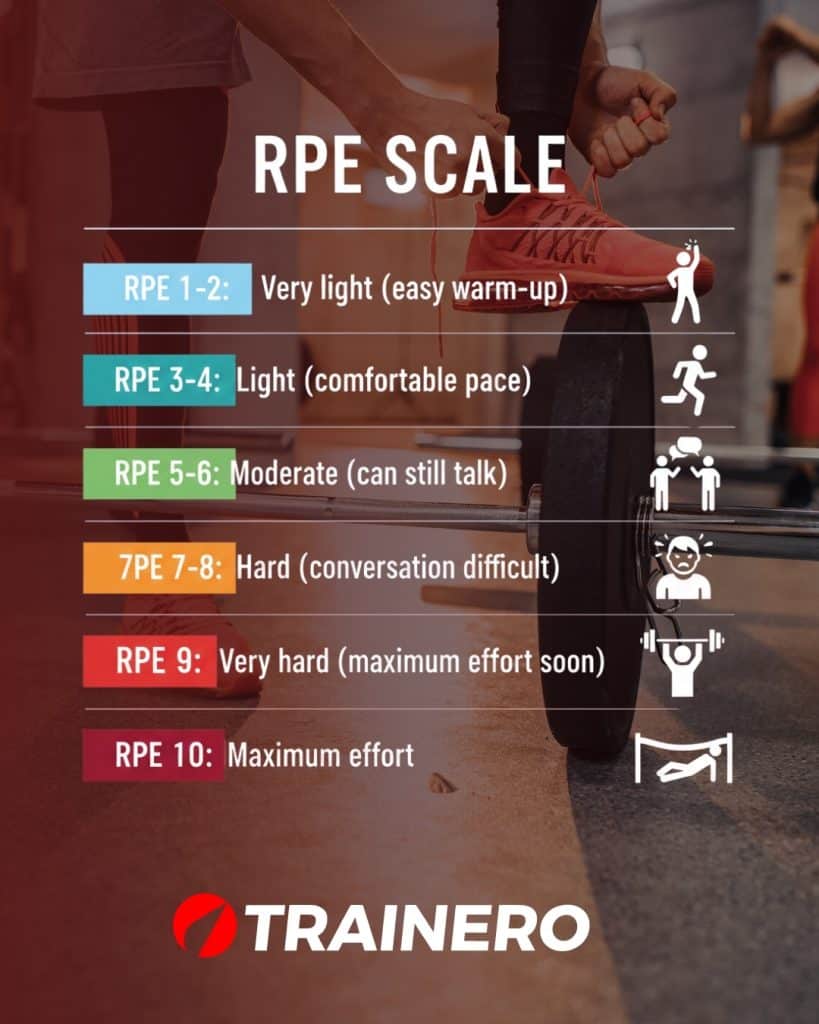
RPE Scale Chart (1–10)
This is the 1–10 RPE scale most coaches and apps use for cardio and general training. The talk test is the easiest way to check yourself: how much can you say out loud at this effort?
| RPE | Effort | Talk test | Approx. % of max heart rate | Typical use |
|---|---|---|---|---|
| 1–2 | Very light | You could sing | Under 55% | Walking, mobility, active recovery |
| 3–4 | Light | Full, easy conversation | 55–70% | Warm-ups, easy runs, zone 2 cardio |
| 5–6 | Moderate | Talking in sentences, breathing deeper | 70–80% | Steady cardio, longer circuits |
| 7 | Hard | A few words at a time | 80–87% | Tempo runs, threshold work |
| 8–9 | Very hard | A word or two | 87–95% | HIIT intervals, race efforts |
| 10 | Maximal | Can’t talk | 95–100% | All-out sprints, max tests |
Heart rate percentages are approximate and vary from person to person. That’s exactly why RPE is useful: it reflects how the effort feels to you today.
The Borg Scale (6–20) and CR10
The original perceived exertion scale was created by Swedish psychologist Gunnar Borg. His Borg RPE scale runs from 6 to 20. The odd numbers are deliberate: for healthy young adults, the rating multiplied by 10 roughly matches heart rate, so a 13 is about 130 beats per minute. Borg later developed the CR10 scale (0–10), which is the basis of the 1–10 scale used in most gyms today.
| Borg 6–20 | Description | Roughly on the 1–10 scale |
|---|---|---|
| 6 | No exertion at all | 0–1 |
| 7–8 | Extremely light | 1 |
| 9–10 | Very light | 2 |
| 11–12 | Light | 3–4 |
| 13–14 | Somewhat hard | 5–6 |
| 15–16 | Hard (heavy) | 7 |
| 17–18 | Very hard | 8–9 |
| 19 | Extremely hard | 9–10 |
| 20 | Maximal exertion | 10 |
In research and clinical settings (cardiac rehab, exercise testing) you’ll mostly meet the 6–20 scale. For day-to-day training, the 1–10 scale is easier to use and easier for clients to understand.

Unlock your fitness potential with Trainero! Get a 14-day free trial and access personalized workout plans, expert coaching, and progress tracking—all in one app. No commitments, just results. Start your free trial today and take your fitness journey to the next level!
RPE for Strength Training: The RIR-Based Scale
In lifting, RPE is usually tied to reps in reserve (RIR): how many more good reps you could have done at the end of a set. This version was popularised in powerlifting and formalised in a resistance-training RPE scale by Zourdos and colleagues (Journal of Strength and Conditioning Research, 2016).
| RPE | RIR (reps in reserve) | How it feels | Typical use |
|---|---|---|---|
| 10 | 0 | Maximal effort, no reps left | 1RM tests, competition |
| 9.5 | 0 | No more reps, but could add a little weight | Heavy top sets |
| 9 | 1 | One more rep possible | Peaking, heavy singles and doubles |
| 8 | 2 | Two solid reps left | Main strength work |
| 7 | 3 | Bar speed still fast | Volume work, technique |
| 5–6 | 4–6 | Comfortable, controlled | Warm-ups, deloads, beginners |
| 1–4 | 6+ | Very light | Recovery, mobility |
A program might say “Back squat 3 × 5 @ RPE 8”. Instead of a fixed weight, you pick a load where every set of five leaves about two reps in the tank. On a great day that load goes up; after a bad night’s sleep it comes down. This built-in flexibility is called autoregulation, and it’s the main reason strength coaches use RPE. More on the counting side in our guide to RIR (reps in reserve).
How to Use RPE in Your Training
For Cardio and Running
- Easy runs and zone 2 work: RPE 3–4. You should be able to hold a conversation. Most of a half marathon training plan is run here.
- Tempo and threshold work: RPE 6–7. Comfortably hard; a few words at a time.
- Intervals and HIIT: RPE 8–9 for the work intervals, RPE 2–3 during recovery. Our 4-week HIIT workout plan uses these targets.
For Lifting
- Warm-up sets: RPE 5–6
- Main working sets: RPE 7–9, depending on the training phase
- RPE 10: rarely, and only for experienced lifters in testing or competition
Beginners should keep most working sets at RPE 6–7 for the first few months. It leaves room for technique and makes rating easier to learn.
Tracking RPE Over Time
Write down the RPE of every working set or interval. Over a few weeks you’ll see patterns: if the same weight moves from RPE 9 to RPE 7, you’ve got stronger; if easy runs keep creeping up to RPE 6, you may need more recovery.
RPE vs Heart Rate: Which Should You Use?
Heart rate is objective, but it lags behind effort in short intervals and drifts upward with heat, dehydration, caffeine and long sessions. RPE reacts instantly and reflects your daily readiness, but it’s subjective and needs some practice to calibrate.
The best approach is to use both: heart rate for steady endurance work, RPE for intervals and lifting, and the two together to spot fatigue. If a normal easy pace suddenly feels like RPE 6, something is off. For the heart rate side, see VO2max and heart rate zones, explained.
Session RPE: Measuring Training Load (for Coaches)
Session RPE (sRPE) turns one number into a simple training-load metric. It was introduced by Carl Foster and colleagues (Journal of Strength and Conditioning Research, 2001) and is now widely used in team sports and coaching.
- About 30 minutes after the session, the athlete rates the whole workout on the 0–10 scale.
- Multiply that rating by the session length in minutes.
- Add up the sessions for the week.
Example: a 60-minute session rated 7 = 420 arbitrary units (AU). Watch for sudden spikes: a week with much higher load than the previous weeks is a common warning sign for overreaching, and it’s easy to spot when you track sRPE every session.
Common RPE Mistakes
- Underrating as a beginner. New lifters often rate sets 1–2 points too low. Calibrate with an occasional AMRAP set to learn what “two reps left” really feels like.
- Rating the whole workout instead of the set. For lifting, rate each working set; for session RPE, rate the whole session afterwards.
- Letting ego decide the number. An honest RPE 9 is more useful than a “heroic” RPE 7.
- Living at RPE 10. Training to failure every set adds fatigue much faster than it adds results.
Frequently Asked Questions
What does RPE mean in the gym?
RPE stands for rate (or rating) of perceived exertion: a 1–10 scale describing how hard a set feels. RPE 10 means maximal effort with no reps left, while RPE 7 means you could still perform about three more reps with good form.
What is the difference between RPE and RIR?
They describe the same thing from different directions: RPE measures how hard the set felt, RIR counts how many reps in reserve you had. RPE 8 equals roughly 2 RIR. Many coaches prescribe strength work as RPE and hypertrophy work as RIR; use whichever your clients understand faster.
What is a good RPE for cardio?
Most cardio should feel like RPE 3–4 (easy, conversational). Add one or two harder sessions a week at RPE 7–9 for tempo work or intervals.
What is the Borg scale?
The Borg scale is the original rating of perceived exertion, created by Gunnar Borg. It runs from 6 (no exertion) to 20 (maximal exertion), and the rating × 10 roughly matches heart rate in healthy young adults.
Is RPE accurate for beginners?
Beginners typically underestimate effort and rate sets 1–2 points too low. Accuracy improves within a few weeks when you pair RPE ratings with occasional AMRAP (as many reps as possible) sets to calibrate what “2 reps left” actually feels like.
How do coaches track clients’ RPE?
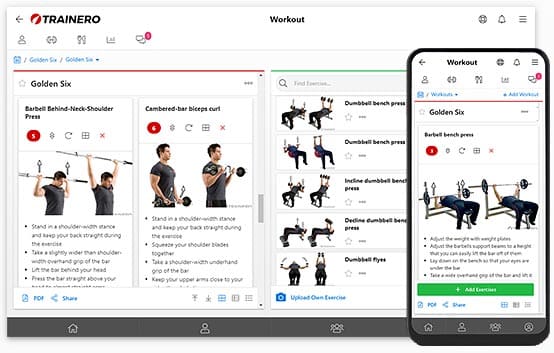
The simplest way is to log a target RPE for each working set and have the client record the actual RPE afterwards. With a coaching platform like Trainero you can build RPE targets directly into programs and see your clients’ reported effort set by set, making autoregulation possible even in remote coaching.
Related Articles
- Essential Exercise Programming: The FITT-VP Framework
- RIR (Reps in Reserve) Explained
- Pronated vs Supinated Grip: When to Use Each
- Why Understanding RPE Protocol Is Crucial When Coaching Women
- How to Get Personal Training Clients
Want to program with RPE and track your clients’ effort automatically? Start your free Trainero trial.