
When Do People Search for a Personal Trainer? 12 Months of Data From 9 Countries
Every coach knows the January rush. Far fewer know that in the US the real peak is May, that in Australia the busy season starts in October, or that in France there are two Januaries a year. We pulled 12 months of search data from nine countries to answer one question: when do people actually search for a personal trainer? The answer depends almost entirely on where you coach — and it should decide when you do your marketing.
Three Seasonal Profiles (Plus One Country With None)
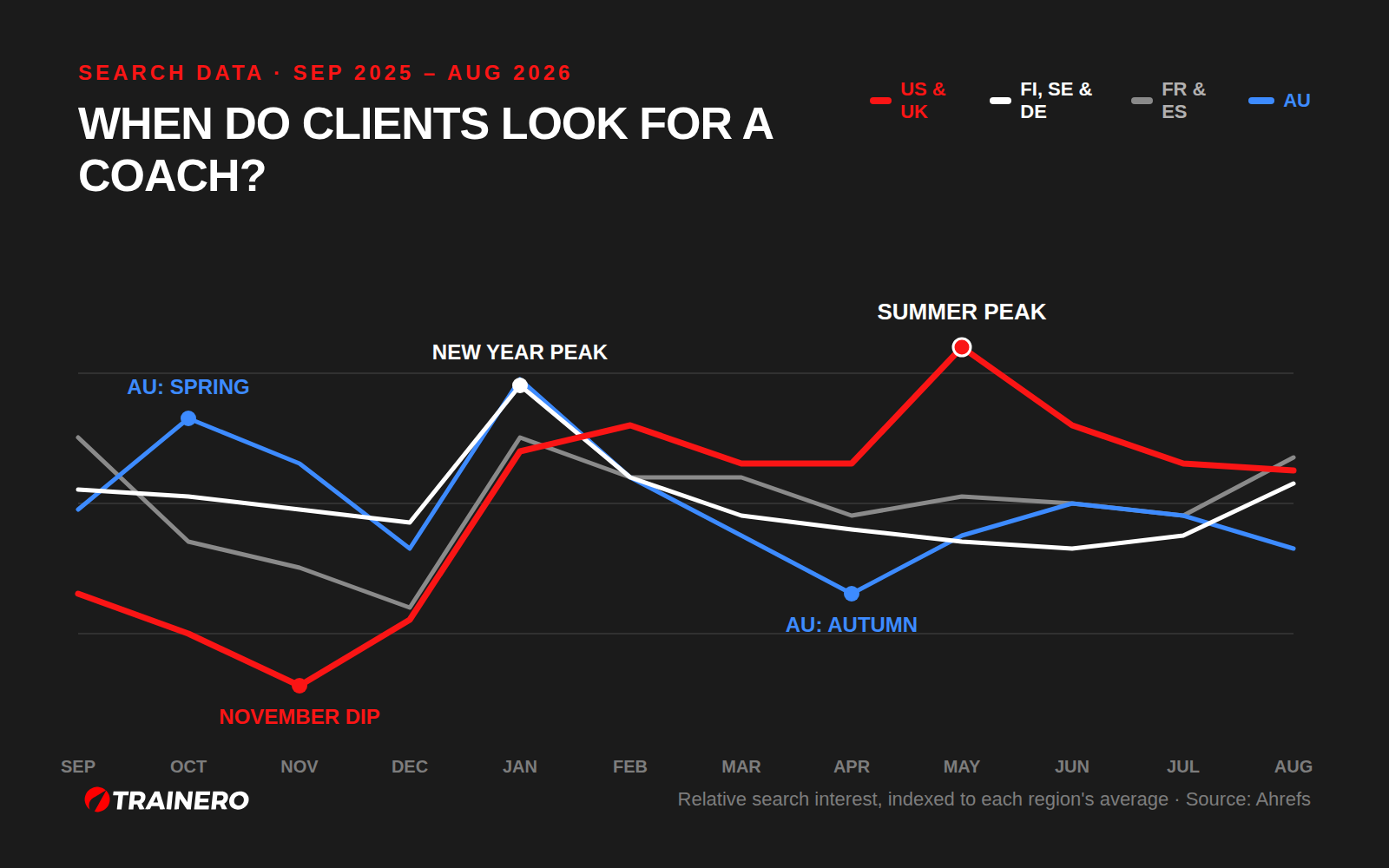
We indexed each region’s monthly search volume against its own yearly average, so the shapes are comparable even though market sizes differ. Nine countries settle into three clear profiles:
| Profile | Countries | Peak | Quietest | What drives it |
|---|---|---|---|---|
| Summer countries | US, UK (+ AU, flipped) | May (24% above average) | November (28% below) | The run-up to beach season |
| January countries | Finland, Sweden, Germany | January (18% above) | Midsummer | New Year resolutions |
| Two-season countries | France, Spain | January and September | December | Resolutions + la rentrée |
The summer countries: US & UK
The January bump is real in both markets — but it isn’t the top. In the US, “personal trainer near me” searches peaked in May 2026 at roughly 319,000 monthly searches, about 17% higher than January, and the whole summer stayed above the New Year level. The deepest quiet of the year lands in November. In other words: in the Anglo markets, the summer body beats the New Year resolution.
Australia: the proof, six months out of phase
If the summer hypothesis is right, the southern hemisphere should mirror it — and it does. Australia’s secondary peak lands in October, their spring, exactly where the US May peak sits. Their quietest month is April, their autumn — the mirror image of the northern November dip. January is still Australia’s single biggest month, but for a charming reason: New Year resolutions and midsummer land in the same week there. Two seasons, one month.
The January countries: Finland, Sweden & Germany
One sharp peak in January — and then the twist: summer is the quietest time of the year. The summer-body rush that defines the Anglo markets simply doesn’t show in Nordic or German search behavior. Whether that’s a lasting cultural difference or a trend that just hasn’t arrived yet is an open question — but for now, a coach in Helsinki and a coach in Miami live in opposite years.
The two-season countries: France & Spain
France and Spain get two January-sized waves a year: the New Year, and September — la rentrée, the collective return to routines after the summer break. Most coaches in these markets prepare for one wave and improvise the other. December, between holidays, is the annual low.
And the Netherlands: no season at all
The flattest curve of all nine countries belongs to the Netherlands: a mild January bump, a steady summer, no September spike. If you coach in a market like this, seasonality matters less than consistency — the same marketing rhythm works all year round.
The Quiet Season Is the Prep Season
Here’s the part that turns this data into a plan. Clients search at the peak — but they find the coach who was visible before it. Content takes weeks to rank, and social trust takes repeated touches before anyone sends a message. As a rule of thumb, your visibility needs to be built about six weeks before your market’s peak.
Which reframes the calendar completely: the quietest month on the chart is the most important one on your marketing calendar. Use the dip to build — your programs, your online store, your content backlog, your systems — so that when the market is ready, so are you. Start with your prices: our guide on how much to charge for personal training includes a quiet-season checklist.
| Your market’s peak | Prep window | What to build |
|---|---|---|
| New Year (all markets) | November–December | Offers, programs and store ready before the holidays; content scheduled for week 1 of January |
| Summer peak, May (US, UK) | March–April | Transformation offers, before-summer challenges, local visibility |
| La rentrée, September (FR, ES) | July–August | Back-to-routine programs, restart offers for lapsed clients |
| Spring, October (AU) | August–September | Pre-summer programs — the southern mirror of the US spring push |
This is also where an online coaching arm earns its keep: online offers barely have a season (we checked — “online personal trainer” searches are nearly flat year-round), so they smooth the revenue dips that local demand creates. And if you’re building that prep-season store and program library in one place, that’s exactly what Trainero is for — programs, store and automated delivery ready before the wave hits.
Methodology
Monthly search volumes from Ahrefs, September 2025 – August 2026. For each country we used the dominant local search term: “personal trainer near me” (US, UK, AU), “personal trainer” (DE, FI, NL), “personlig tränare” (SE), “coach sportif” (FR) and “entrenador personal” (ES). Because absolute volumes aren’t comparable across different terms and market sizes, each country’s months are indexed to that country’s own 12-month average (100), which makes the seasonal shapes directly comparable. For Germany and the Netherlands, Ahrefs models a repeating seasonal profile, so treat those curves as typical seasonality rather than measured month-by-month values. This analysis is a follow-up to our earlier country study: the most searched coaching terms in 12 countries.
FAQ
Is January really the busiest month for personal trainers?
It depends on the market. In the Nordics and Germany, yes — January is the clear annual peak. In the US and UK, January is strong but May is bigger, and demand stays elevated all summer. In France and Spain, September rivals January. Check your own inquiry pattern against your market’s profile before planning around the New Year alone.
When should a coach start marketing for the New Year rush?
By late November. Searches jump in the first days of January, and the coaches who capture them are the ones whose offers, content and booking flow were live before the holidays. November is typically the cheapest month of the year for attention — most competitors go quiet exactly when they should be building.
Why is summer the quiet season in the Nordics?
The search data doesn’t say why, only that it’s consistent: Finnish, Swedish and German searches bottom out in June–July. The likely explanation is cultural — a short, sacred summer built around holidays and cottages rather than gym routines. Whatever the cause, a Nordic coach’s growth season is winter, not summer.
What’s the best month to launch an online coaching offer?
Online coaching demand is remarkably steady year-round, so the honest answer is: launch during your local market’s dip, when you have time to build it properly — and let it be running before your next peak arrives. An online offer is also the best hedge against local seasonality.
The Bottom Line
There is no universal busy season — there’s your market’s busy season. Find your profile, mark your peak, and then do the counterintuitive thing: put your biggest working months where the chart is quietest. When the market is ready, so are you.
Build your prep season in one place — programs, store, automated delivery and client management. Start a free 14-day Trainero trial.