How Much to Charge for Personal Training: Pricing & Packages
“Your prices are too high” is one of the most common objections a personal trainer hears, and it’s rarely about money. Most of the time it means I can’t see what I’m getting. This guide covers how much to charge for personal training, both in person and online: how to find your minimum rate, how to build personal training packages clients understand, what to say in the price conversation, and why autumn is the best time to fix your pricing.
Looking for the client side of the question? Our guide on how much a personal trainer costs shows typical market rates by format and country. This article is for coaches setting their own prices.
You’re Not Too Expensive. You’re Unclear.
People don’t compare your price to their budget. They compare it to what they understand. If the only thing on your price list is “€70 per session”, a potential client can only compare you with the gym’s hourly rate or the cheapest trainer on Instagram, and you lose on price every time.
What clients actually buy isn’t 60 minutes of your time. It’s a plan, weekly accountability, and someone who notices when they disappear. Pricing gets easier the moment your offer shows that.
Step 1: Work Out Your Minimum Rate
Before you look at competitors, calculate the lowest price at which your business actually works. Three numbers are enough:
- Your target income for the year, before tax.
- Your yearly business costs: gym rent or floor fees, insurance, software, education, marketing, equipment.
- Your realistic number of paid sessions per year. Count working weeks after holidays and sick days, not 52.
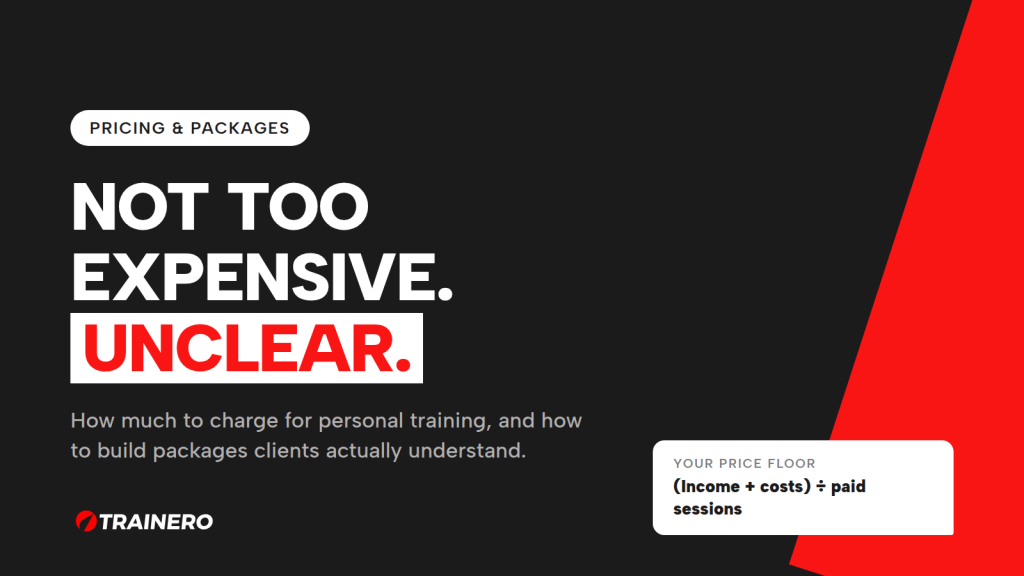
Minimum price per session = (target income + business costs) ÷ paid sessions per year
| Example input | Value |
|---|---|
| Target income (before tax) | €45,000 |
| Business costs per year | €9,000 |
| Working weeks | 46 |
| Paid sessions per week | 20 |
| Paid sessions per year | 920 |
| Minimum price per session | €54,000 ÷ 920 ≈ €59 |
The example is only an illustration; use your own numbers, and check what taxes or VAT apply in your country. The result isn’t your price. It’s your floor. Anything below it means you’re paying to work.
Step 2: Check the Market, Then Decide Where You Sit
Now look at what trainers with similar experience charge in your area and online. In the US, a one-hour session typically costs $40–$120, and online coaching usually runs $100–$400 per month (full breakdown in our personal trainer cost guide).
Then choose your position deliberately. The cheapest trainer in town competes on price forever. A trainer with a clear niche, visible client results and a well-defined package can sit in the upper half of the market, because clients can see the difference. If you haven’t defined your niche and value proposition yet, start with a Lean Canvas for your PT business.
Step 3: Sell Packages, Not Hours
An hourly rate invites clients to compare you with the gym’s hourly rate. A package invites them to compare results. Every package should make four things impossible to misread:
| Element | What to write | Example |
|---|---|---|
| The result and the timeframe | What changes, and by when | “Stronger, pain-free squats in 12 weeks” |
| What happens between sessions | Program, check-ins, messaging, nutrition guidance | “Weekly check-in, app program, form feedback by video” |
| How long it runs | A fixed start and end | “12 weeks, then a re-test” |
| One price per month | Not per hour, not per session | “€520 / month” |
Personal Training Package Examples
Two or three options are enough. More than that and clients stall. An example ladder built on the €59 floor above:
| Package | What’s included | Example price |
|---|---|---|
| Starter (4 weeks) | Assessment, 8 sessions, written program, re-test | €560 |
| Core (12 weeks) | 24 sessions, app program, weekly check-ins, progress review every 4 weeks | €1,560 (€520 / month) |
| Hybrid (monthly) | 2 sessions a month plus app program, weekly check-ins and messaging | €260 / month |
Prices are examples only; set yours from your floor and your market. Most clients choose the middle option, so price it where your ideal revenue per client sits, and make the other two the “easy start” and the “best value”.
How Much to Charge for Online Personal Training
Online coaching is priced per month, not per session. Most online coaches land somewhere in the $100–$400 per month range, depending on how much individual contact is included. Price online coaching by the support you give, not by the fact that it’s online:
- Program only (app program, monthly update, message support): the lower end of your range.
- Program + weekly check-ins (written or video feedback, habit tracking): the middle.
- Program + regular video calls and form reviews: the top tier.
Online clients don’t pay less because they’re getting less. They pay a monthly fee for a plan, feedback and accountability, without needing you in the room. Our guide on how to start online coaching shows a full three-tier structure.
The Price Conversation: Say This, Not That
Most pricing problems happen in the conversation, not on the price list.
| Not this | Say this instead |
|---|---|
| “It’s €70 per session.” | “The 12-week package is €1,560. Here’s exactly what’s in it.” |
| “I know it’s quite a lot…” | Say the price, then stop talking. |
| “I could give you a discount.” | “I can do a shorter package.” Shrink the offer, never the value. |
| “Let me know what you think!” | “Would you like to start on Monday or Wednesday?” |
The hardest part isn’t the number; it’s the silence after you say it. Most coaches talk themselves into a discount nobody asked for.
How to Raise Your Prices Without Losing Clients
- Give notice. Four to eight weeks, in writing.
- Start with new clients. Raise the price for new clients first; move existing clients over at the next package renewal.
- Add something visible, however small: a monthly progress review, a new check-in format, a better app.
- Explain why once, then stop apologising.
A message you can adapt:
“Hi Anna! From 1 January my 12-week package will be €1,680. Your current package stays as it is until it ends in February, and when you renew you’ll also get a monthly progress review with your numbers side by side. Thank you for training with me. I’m excited about the next 12 weeks.”
Do This Now, Not in January
Timing matters more than most coaches think. Our analysis of 12 months of personal trainer search data from nine countries shows that in the US and UK the quietest month of the year is November, and January brings a clear bump. In Finland, Sweden and Germany, January is the single biggest month of the year.
Nobody designs a good offer while their inbox is full. Use the quiet weeks to build, so your new packages and prices are live before the rush. January is for selling. October and November are for building.
Your quiet-season pricing checklist:
- Calculate your minimum price per session with this year’s real numbers
- Rewrite your packages so each one shows the result, timeframe, support and one monthly price
- Decide on any price increase and send the notice to existing clients
- Update your website, booking page and online store
- Practise the price conversation out loud until you can say the number and stay quiet
Frequently Asked Questions
How much should I charge as a personal trainer?
Start from your minimum rate: your target income plus business costs, divided by the number of sessions you can realistically sell in a year. Then compare it with local and online market rates and position yourself by experience and niche. In the US, typical one-hour sessions cost $40–$120.
How much should I charge for online personal training?
Most online coaches charge monthly, typically $100–$400 per month. Price by the level of support: program-only coaching at the lower end, weekly check-ins in the middle, and regular video calls and form reviews at the top.
Should I charge per session or per package?
Packages work better for most trainers. They give clients a clear result and timeframe, make your income more predictable, and move the conversation away from comparing hourly rates.
What should a personal training package include?
The result and timeframe, what happens between sessions (program, check-ins, messaging), how long it runs, and one monthly price. Add an assessment at the start and a re-test at the end so progress is visible.
When should I raise my prices?
When your calendar is consistently full, when you’ve added qualifications or results, or at least every year or two to keep up with costs. Give four to eight weeks’ notice and start with new clients.
Price Your Coaching, Then Deliver It Professionally
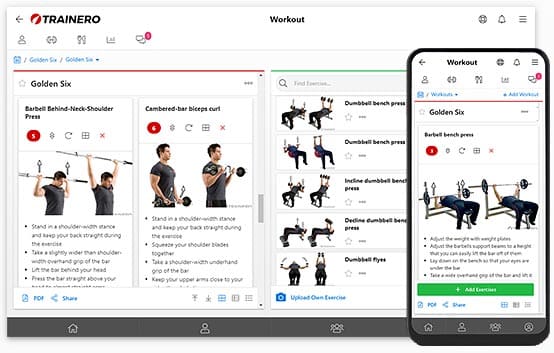
A clear package is easier to sell when the delivery looks just as clear. With Trainero you can sell packages in your own online store, deliver programs in an app and run check-ins without spreadsheets. Clients see exactly what they’re paying for. Try Trainero free for 14 days.
Related reading: Where your coaching business leaks profit · How to get personal training clients · The week-three motivation gap

Unlock your fitness potential with Trainero! Get a 14-day free trial and access personalized workout plans, expert coaching, and progress tracking—all in one app. No commitments, just results. Start your free trial today and take your fitness journey to the next level!